An ambush in the mountains of Lebanon set off one of the most shocking diplomatic crises of the twelfth century, pitting the Templars against both their king and their supposed Nizari allies. This episode reveals how ambition, fear and rivalry shaped the fragile politics between crusaders and Assassins.
By Steve Tibble
The small party of Arab and Persian travellers were strung out along what might have been called a road, but which was, for all practical purposes, just a dry and increasingly rocky path. They were on the lower foothills of the Lebanon mountains, slowly working their way home, treading wearily up the tightly winding slopes. Social standing and the geography of their ascent were matched in a strange symmetry, from the highest to the lowest.
At the front of the group were the well-groomed and clearly expensive horses – animals which befitted the status of the diplomats who were riding them. These were men at ease with themselves and their world, looking ahead, quietly confident – and thinking about the discussions that had taken place over the previous days. Their measured voices occasionally rose above the rhythmic clattering of their horses’ hooves, working through the possible responses to what they had heard, the different strategies and permutations to arrive at the most satisfactory outcomes. There was much to reflect on, but their discussions had been promising.
An Ambush in the Lebanon Mountains
Behind them, riding on nags and each leading a small packhorse, were their retainers and squires. These were men focused on the practical work of the day, looking around for any possible trouble, particularly with the animals, and trying to keep the small convoy moving.
At the very end of the group were the lowest in the social hierarchy, dirty and poorly dressed – young mule drivers with their surly charges, and the old men who were tasked with fetching the water and the firewood.
The party rounded a sharp corner. From behind the outcrop of an overhanging rock face, a dozen heavily armoured knights charged down towards them. Surprise was total. With only a few short but seemingly endless seconds before the heavy cavalry hit them, each man in the column acted instinctively.
The men at the rear turned to run, leaving anything of value as far behind as possible. The squires dropped the reins of their packhorses and began to peel off from the path, scattering left and right, at first stunned but acting on reflex in the face of the chaos that was about to collide into them.
The riders at the front of the group, completely unprepared and closest to their attackers, had no chance. They reached down to grasp their swords, but did not even have time to get them out of their scabbards. The knights hurtled into them, visceral and frightening, horseflesh and rider merging into a single unstoppable force.
The fight, or more accurately massacre, was over in a few intense seconds, punctuated by fragile splinters of pain and violence. No one was looking for prisoners. There were sweeping, ghastly flashes of razor-sharp swords. The light briefly shifted on the palette of blood mist spraying from arterial wounds, raw and vibrant colours on the dry yellow rock surface of the mountain path. And the primal sound of the last screams of the wounded – men who were, they knew, about to die.
The aftermath was unnaturally quiet – a momentary silence laden with sweat, adrenaline and relief. The leader of the ambushers took off his helmet, revealing a grizzled and sunburnt face. Shockingly, a livid scar seared its way across his cheek, up towards a missing eye, and the permanent reproach of a weeping, crudely stitched-up socket. The knight searched through the papers of the dead envoys, took out the contents of their diplomatic pouches and stuffed them into his saddlebags. His job that day was done.
In the lawless, mountainous marcher-lands of the Middle East such violence was all too common. But this was different. This was a moment when two legends collided – with bloody consequences.
The Templars and the Assassins.
The Assassins’ Embassy to Jerusalem, 1173–74
King Amalric of Jerusalem – France, Lyon. Bibliothèque municipale, Ms 828 f. 238v
Like the princes of Antioch, the kings of Jerusalem were open to pragmatic suggestions of alliance with the Nizaris – there was always the tempting possibility of bringing them into an anti-Sunni alliance that would benefit both parties. In the early 1170s discussions between the sect and King Amalric of Jerusalem were far advanced. The Assassins went so far as to hint that, with the appropriate incentives, they might even convert to a form of Christianity – or at least that is what some of the Franks chose to believe.
The famous Frankish chronicler, William of Tyre, was a thoughtful commentator and a close confidante of the king. He had been used by Amalric on high-level diplomatic and intelligence-gathering operations in the past. He was likely to have been party to these sensitive discussions. As the Archbishop of Tyre, he would, at the very least, have heard first-hand accounts of their activities.
William left a detailed account of the negotiations. Manpower was a long-standing problem for the crusaders and, correctly or not, the Assassins were believed to be numerous enough to be serious allies. ‘In the province of Tyre’, William later wrote, the Assassins lived, ‘numbering some 60,000 or more, as I have often heard said, who possess ten castles, each with surrounding villages.’
Sinan’s charismatic leadership was also well known, even to the Franks. William was suitably impressed. ‘During our times,’ he gushed, ‘they happened to choose as ruler over them a very eloquent man, of subtle and brilliant intelligence. Contrary to the habits of his ancestors, this man possessed the books of the Evangels and…[he] tried to follow the marvellous precepts of Christ and also the apostolic doctrine’. His people, wrote William, ‘call him simply the Old Man’.
According to this account, Sinan had ‘sent to our lord the king [Amalric] a wise man by the name of [Abdullah]. This man, skilled in discussions, eloquent and fully conversant with his leader’s religion, carried secret propositions, the first and foremost of which was that if the brothers of the Knighthood of the Temple who possessed castles on the Assassins’ borders were willing to forego the two thousand gold pieces that were paid annually by his people somewhat like a tribute, and henceforth show brotherly affection, the Assassins would join the Christian faith and accept baptism’.
Sinan depicted in the game Assassin’s Creed
The king agreed to all this, and, keen to get a deal, even said that he would fully compensate the Templars for their loss of income. The Assassins’ ambassador stayed at the royal court for some time, finalising the wording of the agreement. All that needed to happen now was for the final document to be ratified by Sinan. The Nizari delegation were given Frankish bodyguards and guides and set off back home. An historic deal was close.
But it was not to be. Just as the party was leaving the king’s territory, shortly after the royal escort peeled off back home, the Templars struck. Picked men from their local garrisons sprang an ambush. The Assassins’ negotiating team were relaxed, feeling safe and confident. At this moment, when they were at their most vulnerable, ‘some of the Knights of the Temple rushed upon the party with drawn swords and killed the envoy. The latter…was pursuing his journey without caution, in full reliance upon the king’s safe conduct and the sincere good faith of our nation’.
This was a shocking act, shattering the implicit promise of royal protection. In a deeply religious age, breaking an oath meant putting one’s immortal soul in danger, as well as one’s credibility as a leader. The incident was serious enough to bring the entire kingdom to the brink of civil war – and ‘by this crime’, wrote William, the Templars ‘brought upon themselves the charge of treason’.
They had gone too far. The king exploded ‘with violent anger. Almost frenzied, he summoned the barons and, declaring that the outrage amounted to an injury against himself, he demanded their advice as to the course of action to be adopted. The barons were of one mind that such wickedness should not be passed over’. Two of the king’s nobles, the marvellously named Seiher of Mamedunc and Godescalous of Turout, were sent to the Templars to demand redress for the outrage.
Odo of Saint-Amand, the master, responded in a deliberately insulting way, calculated to infuriate an already angry king. He merely replied that he had given the guilty man a penance to fulfil and was going to send him to Rome – until then, the master ‘forbade anyone…to lay violent hands upon the said brother’.
The actual perpetrator was a striking figure – a grizzled Templar veteran called Walter of Mesnil, described as ‘an evil one-eyed man…a totally worthless man’. It was clear to everyone that he was the closest thing the order had to a contract killer – and that he was only acting under orders. The king and his advisers were sure that the ambush and murder ‘was done with the cognizance of the brethren’.
Royal Fury and the Collapse of Negotiations
King Amalric – BNF MS Français 2754 fol 71r
The Templars had deliberately derailed the process of forming an alliance with the Assassins. Their motives in doing so are not entirely clear. The sums of money involved were small, relative to the order’s total income – and even that relatively minor financial inconvenience was going to be underwritten by King Amalric. The real reason probably lay in the precedent it might have set and, perhaps more importantly, the bad blood that undoubtedly existed between the military order and the Assassins.
William of Tyre, who was personally involved in the matter at this point and had reviewed the correspondence, was shocked on his king’s behalf. He wrote that Odo of Saint-Amand had ‘added other remarks [in his letter to the king] dictated by the spirit of overweening arrogance with which he was possessed.’ William was party to the details but, frustratingly for us, decided that ‘it is unnecessary to record them’.
These ‘remarks’ were almost certainly a deliberate and massively insulting provocation – and William did not record them because they were too embarrassing to commit to vellum. The Templars, always confident to the point of hubris, were of the opinion that they had a semi-independent, self-governing principality on the borders of the county of Tripoli – and this was where the massacre took place. The king of Jerusalem, Odo was clearly implying, should mind his own business.
William’s evidence is given independent corroboration by the account of an English cleric, Walter Map, written in 1182. In it, Walter suggested that the negotiations had indeed been far advanced and that the Assassins’ envoy had been ‘despatched to the Patriarch [of Jerusalem] to bring back priests and deacons who would be able to baptise them and give them the full sacraments of the faith. This pagan was ambushed en route by the Templars of the city, and killed…When the Old Man [of the Mountain] learnt about the ambush, under the influence of the devil, he put a stop to his new Christian devotion…This was deplored by the patriarch and the king, but neither could exact revenge on the Templars.’ Shockingly (and doubly so because it contained an element of truth) Walter finished by suggesting that ‘the king could not [punish them] because he is smaller than their little finger’.
That was a rare insult, particularly given that Amalric was huge – the obese king was described by one who knew him well as being ‘taller than many…[and] excessively fat, with breasts like those of a woman hanging down to his waist.’ But, man-boobs or not, ‘small’ Amalric was furious beyond measure. Even on a good day, famously short tempered and lacking in bonhomie, he was unlikely to top anyone’s list of ideal companions for a beach holiday.
But this outrage, following so closely on the murder of the Assassins’ emissaries, pushed him to new levels of apoplexy. The Latin Kingdom of Jerusalem was outnumbered and surrounded by enemies. Saladin was making inroads on an almost daily basis. The crusaders needed all the friends they could get, even in the most unlikely of places.
The Templars, in their pique and arrogance, had ruined all that.
Steve Tibble, an honorary research associate at Royal Holloway, University of London, has a new book out – Assassins and Templars: A Battle in Myth and Blood – from Yale University Press. It tells the true history behind the hugely popular video game Assassin’s Creed and the medieval world’s two most extraordinary organisations, tracing their origins, strategies, violent clashes, and enduring legacy in myth and memory.
You can get your copy of Assassins and Templars: A Battle in Myth and Blood through

An ambush in the mountains of Lebanon set off one of the most shocking diplomatic crises of the twelfth century, pitting the Templars against both their king and their supposed Nizari allies. This episode reveals how ambition, fear and rivalry shaped the fragile politics between crusaders and Assassins.
By Steve Tibble
The small party of Arab and Persian travellers were strung out along what might have been called a road, but which was, for all practical purposes, just a dry and increasingly rocky path. They were on the lower foothills of the Lebanon mountains, slowly working their way home, treading wearily up the tightly winding slopes. Social standing and the geography of their ascent were matched in a strange symmetry, from the highest to the lowest.
At the front of the group were the well-groomed and clearly expensive horses – animals which befitted the status of the diplomats who were riding them. These were men at ease with themselves and their world, looking ahead, quietly confident – and thinking about the discussions that had taken place over the previous days. Their measured voices occasionally rose above the rhythmic clattering of their horses’ hooves, working through the possible responses to what they had heard, the different strategies and permutations to arrive at the most satisfactory outcomes. There was much to reflect on, but their discussions had been promising.
An Ambush in the Lebanon Mountains
Behind them, riding on nags and each leading a small packhorse, were their retainers and squires. These were men focused on the practical work of the day, looking around for any possible trouble, particularly with the animals, and trying to keep the small convoy moving.
At the very end of the group were the lowest in the social hierarchy, dirty and poorly dressed – young mule drivers with their surly charges, and the old men who were tasked with fetching the water and the firewood.
The party rounded a sharp corner. From behind the outcrop of an overhanging rock face, a dozen heavily armoured knights charged down towards them. Surprise was total. With only a few short but seemingly endless seconds before the heavy cavalry hit them, each man in the column acted instinctively.
The men at the rear turned to run, leaving anything of value as far behind as possible. The squires dropped the reins of their packhorses and began to peel off from the path, scattering left and right, at first stunned but acting on reflex in the face of the chaos that was about to collide into them.
The riders at the front of the group, completely unprepared and closest to their attackers, had no chance. They reached down to grasp their swords, but did not even have time to get them out of their scabbards. The knights hurtled into them, visceral and frightening, horseflesh and rider merging into a single unstoppable force.
The fight, or more accurately massacre, was over in a few intense seconds, punctuated by fragile splinters of pain and violence. No one was looking for prisoners. There were sweeping, ghastly flashes of razor-sharp swords. The light briefly shifted on the palette of blood mist spraying from arterial wounds, raw and vibrant colours on the dry yellow rock surface of the mountain path. And the primal sound of the last screams of the wounded – men who were, they knew, about to die.
The aftermath was unnaturally quiet – a momentary silence laden with sweat, adrenaline and relief. The leader of the ambushers took off his helmet, revealing a grizzled and sunburnt face. Shockingly, a livid scar seared its way across his cheek, up towards a missing eye, and the permanent reproach of a weeping, crudely stitched-up socket. The knight searched through the papers of the dead envoys, took out the contents of their diplomatic pouches and stuffed them into his saddlebags. His job that day was done.
In the lawless, mountainous marcher-lands of the Middle East such violence was all too common. But this was different. This was a moment when two legends collided – with bloody consequences.
The Templars and the Assassins.
The Assassins’ Embassy to Jerusalem, 1173–74
Like the princes of Antioch, the kings of Jerusalem were open to pragmatic suggestions of alliance with the Nizaris – there was always the tempting possibility of bringing them into an anti-Sunni alliance that would benefit both parties. In the early 1170s discussions between the sect and King Amalric of Jerusalem were far advanced. The Assassins went so far as to hint that, with the appropriate incentives, they might even convert to a form of Christianity – or at least that is what some of the Franks chose to believe.
The famous Frankish chronicler, William of Tyre, was a thoughtful commentator and a close confidante of the king. He had been used by Amalric on high-level diplomatic and intelligence-gathering operations in the past. He was likely to have been party to these sensitive discussions. As the Archbishop of Tyre, he would, at the very least, have heard first-hand accounts of their activities.
William left a detailed account of the negotiations. Manpower was a long-standing problem for the crusaders and, correctly or not, the Assassins were believed to be numerous enough to be serious allies. ‘In the province of Tyre’, William later wrote, the Assassins lived, ‘numbering some 60,000 or more, as I have often heard said, who possess ten castles, each with surrounding villages.’
Sinan’s charismatic leadership was also well known, even to the Franks. William was suitably impressed. ‘During our times,’ he gushed, ‘they happened to choose as ruler over them a very eloquent man, of subtle and brilliant intelligence. Contrary to the habits of his ancestors, this man possessed the books of the Evangels and…[he] tried to follow the marvellous precepts of Christ and also the apostolic doctrine’. His people, wrote William, ‘call him simply the Old Man’.
According to this account, Sinan had ‘sent to our lord the king [Amalric] a wise man by the name of [Abdullah]. This man, skilled in discussions, eloquent and fully conversant with his leader’s religion, carried secret propositions, the first and foremost of which was that if the brothers of the Knighthood of the Temple who possessed castles on the Assassins’ borders were willing to forego the two thousand gold pieces that were paid annually by his people somewhat like a tribute, and henceforth show brotherly affection, the Assassins would join the Christian faith and accept baptism’.
The king agreed to all this, and, keen to get a deal, even said that he would fully compensate the Templars for their loss of income. The Assassins’ ambassador stayed at the royal court for some time, finalising the wording of the agreement. All that needed to happen now was for the final document to be ratified by Sinan. The Nizari delegation were given Frankish bodyguards and guides and set off back home. An historic deal was close.
But it was not to be. Just as the party was leaving the king’s territory, shortly after the royal escort peeled off back home, the Templars struck. Picked men from their local garrisons sprang an ambush. The Assassins’ negotiating team were relaxed, feeling safe and confident. At this moment, when they were at their most vulnerable, ‘some of the Knights of the Temple rushed upon the party with drawn swords and killed the envoy. The latter…was pursuing his journey without caution, in full reliance upon the king’s safe conduct and the sincere good faith of our nation’.
This was a shocking act, shattering the implicit promise of royal protection. In a deeply religious age, breaking an oath meant putting one’s immortal soul in danger, as well as one’s credibility as a leader. The incident was serious enough to bring the entire kingdom to the brink of civil war – and ‘by this crime’, wrote William, the Templars ‘brought upon themselves the charge of treason’.
They had gone too far. The king exploded ‘with violent anger. Almost frenzied, he summoned the barons and, declaring that the outrage amounted to an injury against himself, he demanded their advice as to the course of action to be adopted. The barons were of one mind that such wickedness should not be passed over’. Two of the king’s nobles, the marvellously named Seiher of Mamedunc and Godescalous of Turout, were sent to the Templars to demand redress for the outrage.
Odo of Saint-Amand, the master, responded in a deliberately insulting way, calculated to infuriate an already angry king. He merely replied that he had given the guilty man a penance to fulfil and was going to send him to Rome – until then, the master ‘forbade anyone…to lay violent hands upon the said brother’.
The actual perpetrator was a striking figure – a grizzled Templar veteran called Walter of Mesnil, described as ‘an evil one-eyed man…a totally worthless man’. It was clear to everyone that he was the closest thing the order had to a contract killer – and that he was only acting under orders. The king and his advisers were sure that the ambush and murder ‘was done with the cognizance of the brethren’.
Royal Fury and the Collapse of Negotiations
The Templars had deliberately derailed the process of forming an alliance with the Assassins. Their motives in doing so are not entirely clear. The sums of money involved were small, relative to the order’s total income – and even that relatively minor financial inconvenience was going to be underwritten by King Amalric. The real reason probably lay in the precedent it might have set and, perhaps more importantly, the bad blood that undoubtedly existed between the military order and the Assassins.
William of Tyre, who was personally involved in the matter at this point and had reviewed the correspondence, was shocked on his king’s behalf. He wrote that Odo of Saint-Amand had ‘added other remarks [in his letter to the king] dictated by the spirit of overweening arrogance with which he was possessed.’ William was party to the details but, frustratingly for us, decided that ‘it is unnecessary to record them’.
These ‘remarks’ were almost certainly a deliberate and massively insulting provocation – and William did not record them because they were too embarrassing to commit to vellum. The Templars, always confident to the point of hubris, were of the opinion that they had a semi-independent, self-governing principality on the borders of the county of Tripoli – and this was where the massacre took place. The king of Jerusalem, Odo was clearly implying, should mind his own business.
William’s evidence is given independent corroboration by the account of an English cleric, Walter Map, written in 1182. In it, Walter suggested that the negotiations had indeed been far advanced and that the Assassins’ envoy had been ‘despatched to the Patriarch [of Jerusalem] to bring back priests and deacons who would be able to baptise them and give them the full sacraments of the faith. This pagan was ambushed en route by the Templars of the city, and killed…When the Old Man [of the Mountain] learnt about the ambush, under the influence of the devil, he put a stop to his new Christian devotion…This was deplored by the patriarch and the king, but neither could exact revenge on the Templars.’ Shockingly (and doubly so because it contained an element of truth) Walter finished by suggesting that ‘the king could not [punish them] because he is smaller than their little finger’.
That was a rare insult, particularly given that Amalric was huge – the obese king was described by one who knew him well as being ‘taller than many…[and] excessively fat, with breasts like those of a woman hanging down to his waist.’ But, man-boobs or not, ‘small’ Amalric was furious beyond measure. Even on a good day, famously short tempered and lacking in bonhomie, he was unlikely to top anyone’s list of ideal companions for a beach holiday.
But this outrage, following so closely on the murder of the Assassins’ emissaries, pushed him to new levels of apoplexy. The Latin Kingdom of Jerusalem was outnumbered and surrounded by enemies. Saladin was making inroads on an almost daily basis. The crusaders needed all the friends they could get, even in the most unlikely of places.
The Templars, in their pique and arrogance, had ruined all that.
You can get your copy of Assassins and Templars: A Battle in Myth and Blood through
Yale University Press website
Amazon.com
Amazon.ca
Amazon.co.uk
To learn more about Steve, please visit his website or follow him on Instagram
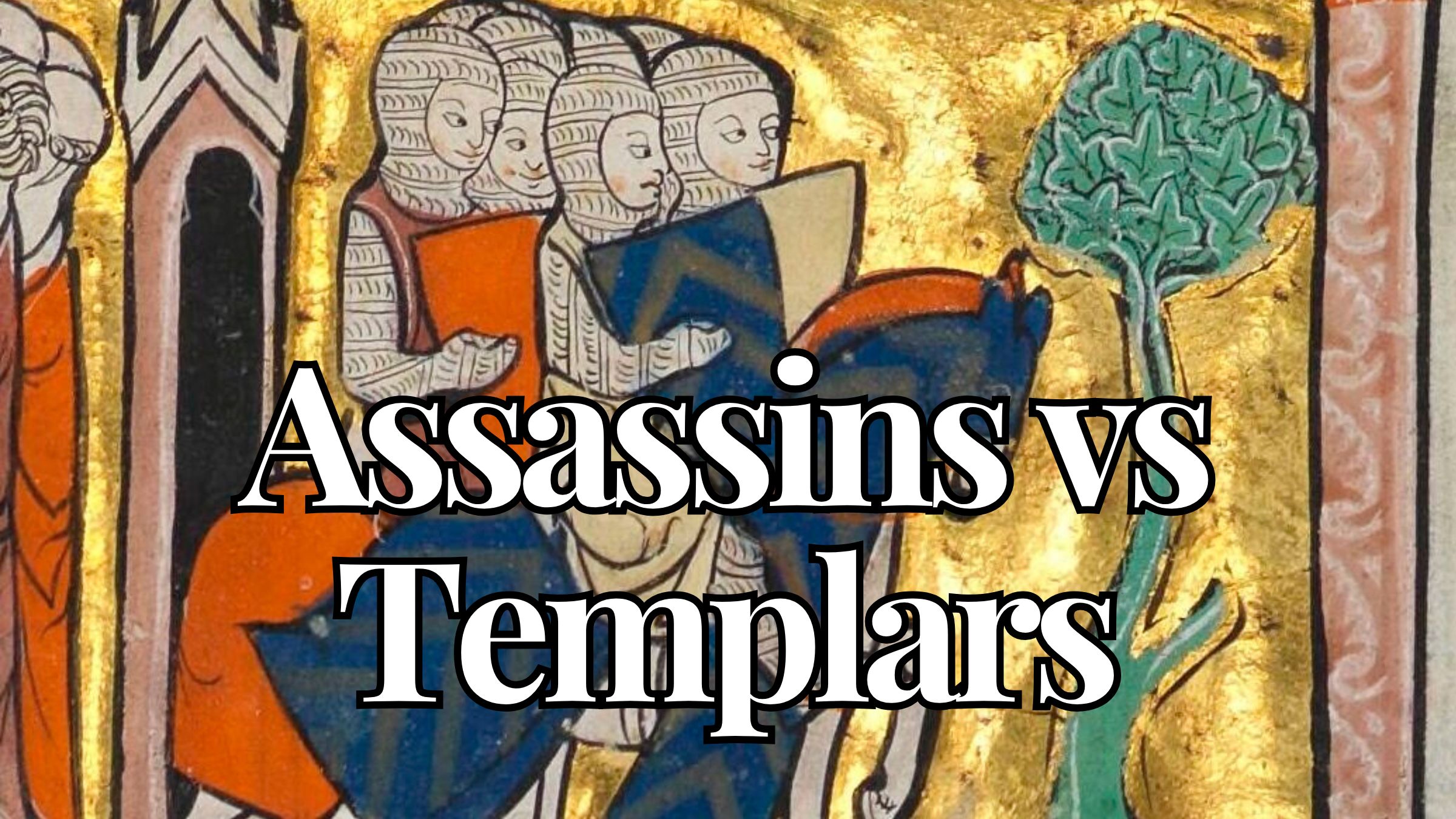
Top Image: Templars riding off – BNF MS Français 770, fol. 313
Subscribe to Medievalverse
Related Posts