Sumptuary Legislation and Conduct Literature in Late Medieval England
By Ariadne Woodward
Master’s Thesis, Concordia University, 2016
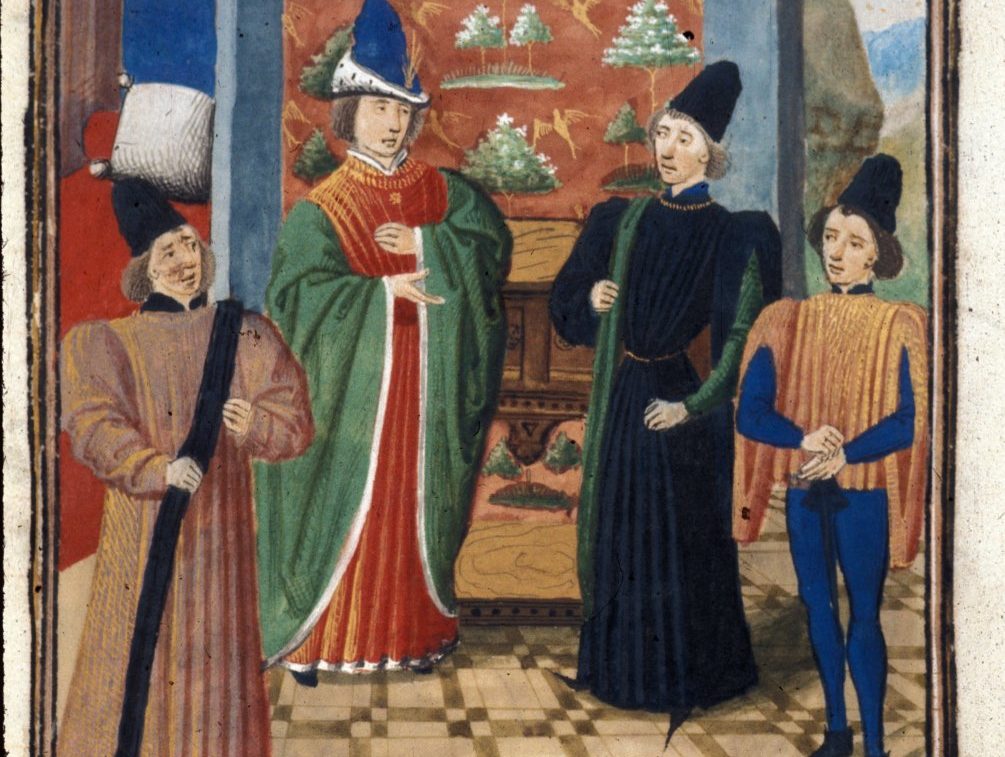
Image demonstrating the variety of styles of male dress after the shift that took place in the mid fourteenth century. British Library, Harley 4380, fol 108.
Abstract: This study is an examination of attempts to control dress in late medieval England. Concerns about dress expressed in sumptuary legislation and conduct literature were demonstrative of deeper anxieties about gender, class, status, the interrelationship between medieval contemporaries, nationhood and morality. Clothing was especially targeted because it was an important marker of status and of individuals’ morals.
However, the lack of evidence of enforcement of sumptuary legislation and the limited scope of this type of legislation demonstrates a certain ambivalence towards a strict control of what individuals wore. Clothing played an important role in social negotiations. Late medieval society was extremely hierarchical and yet these hierarchies were somewhat fluid, which was both a source of confusion and opportunity.
Introduction: Clothing in the Middle Ages, much like today, served numerous functions. On the one hand, clothing, much like shelter and food, is one of the essential needs for humans to survive. Clothing protects us from the elements, and therefore is a fundamental human need. However, the need that humans have for clothing is embedded in culture and wearing clothing is not simply a functional act. The protective aspect of clothing cannot explain why clothing comes in various styles and is often decorated. Natural processes, such as birth and death, are embedded in traditions and rituals that are imbued with meaning. This is also true about the clothing we wear; clothing has a deeply symbolic character.

Sumptuary Legislation and Conduct Literature in Late Medieval England
By Ariadne Woodward
Master’s Thesis, Concordia University, 2016
fourteenth century. British Library, Harley 4380, fol 108.
Abstract: This study is an examination of attempts to control dress in late medieval England. Concerns about dress expressed in sumptuary legislation and conduct literature were demonstrative of deeper anxieties about gender, class, status, the interrelationship between medieval contemporaries, nationhood and morality. Clothing was especially targeted because it was an important marker of status and of individuals’ morals.
However, the lack of evidence of enforcement of sumptuary legislation and the limited scope of this type of legislation demonstrates a certain ambivalence towards a strict control of what individuals wore. Clothing played an important role in social negotiations. Late medieval society was extremely hierarchical and yet these hierarchies were somewhat fluid, which was both a source of confusion and opportunity.
Click here to read this thesis from Concordia University
Subscribe to Medievalverse
Related Posts