Performative Rituals for Conception and Childbirth in England, 900–1500
By Peter Murray Jones and Lea T. Olsan
Bulletin of the History of Medicine, Vol.89:3 (2015)
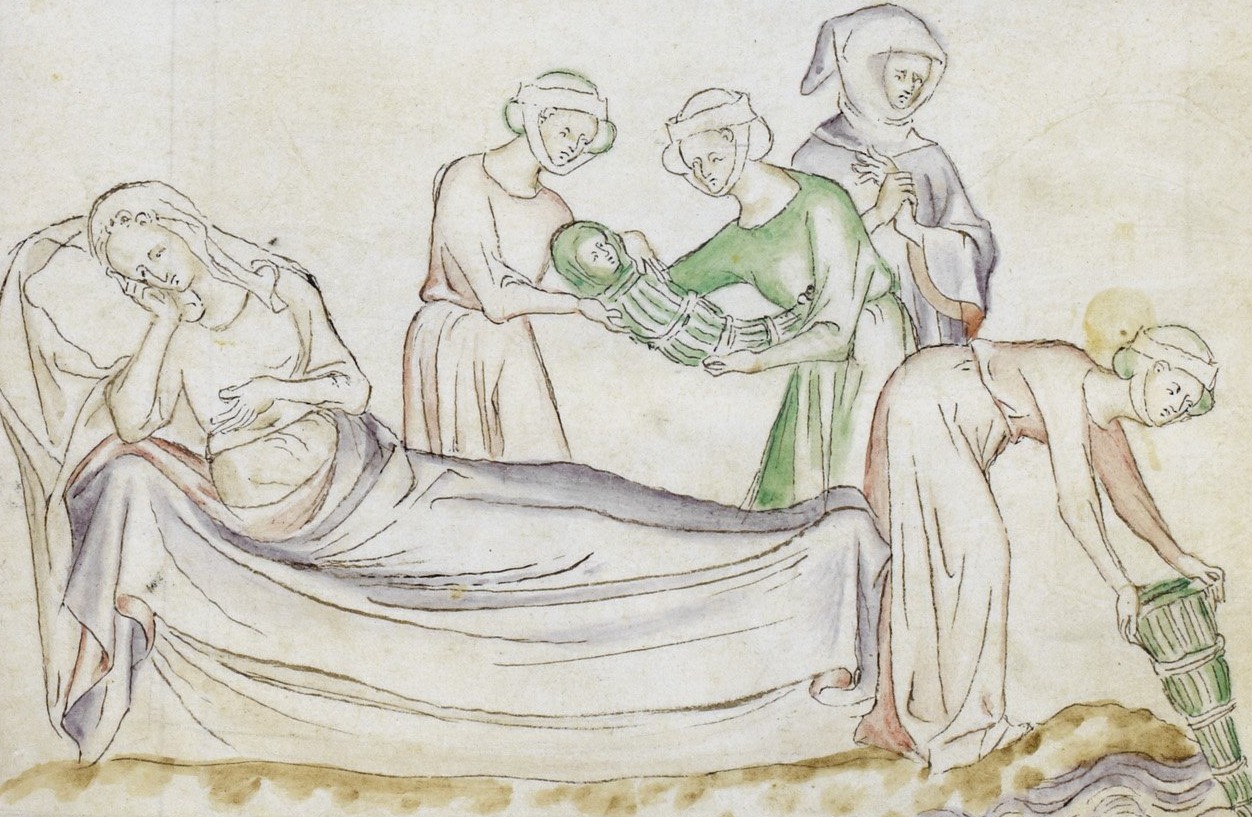
British Library – Royal 2 B VII f. 22v
Abstract: This study proposes that performative rituals—that is, verbal and physical acts that reiterate prior uses—enabled medieval women and men to negotiate the dangers and difficulties of conception and childbirth. It analyzes the rituals implicated in charms, prayers, amulets, and prayer rolls and traces the circulation of such rituals within medieval English society. Manuscript records from the Anglo-Saxon period to the late Middle Ages offer evidence of the interaction of oral and written means of communicating these rituals. Certain rituals were long-lived, though variants were introduced over time that reflected changing religious attitudes and the involvement of various interested parties, including local healers, doctors, and medical practitioners, as well as monks, friars, and users of vernacular remedy books. Although many of those who recommended or provided assistance through performative rituals were males, the practices often devolved upon women themselves, and their female companions or attendants.
Introduction: Other than ubiquitous death, birth holds the prime place in medieval life and thought. Birth rights secured monarchies and ownership of lands; elaborate genealogies established familial authority in the secular world. Biblical genealogies commemorated in liturgy determined the identity of Christ. The birth of Christ and the Virgin Mary’s motherhood became central to Christian faith, doctrine, and religious practice. Images of Christ’s conception and nativity adorned innumerable prayer books and psalters as aids to meditation and prayer. Early ceremonies of marriage emphasized the conception of offspring under the biblical rubric of Genesis 1:28: “Be fruitful and multiply.” Baptism of infants, whose souls might be in jeopardy if they died during delivery, brought religious pressures to bear on those in attendance at births of children. Theories of conception and growth of the fetus as well as the moment when the fetus gained a human soul were subjects of debate, medical, legal, and theological.
Medical knowledge in Western Europe concerning conception and how to promote it or prevent it crystallized in texts translated into Latin from Arabic at Monte Cassino by Constantine the African in the eleventh century.1 This learning spread to England from the eleventh to the thirteenth centuries and was translated into English and French. From the fourteenth century gynecological texts taken from scholastic medical sources were excerpted, augmented, and widely dispersed in vernacular languages. Existing alongside such medical knowledge and writings about women’s matters was a range of ritual practices employed at crucial moments in the life experience of those who were attempting to conceive, maintain pregnancy successfully, and safely deliver healthy offspring. In England from the Anglo-Saxon period into the early modern, secular and religious rituals were recorded in a rather scattered manner in manuscripts. Some rituals were recorded because they had proved themselves effective in performance; some were preserved for future use by couples and families whose hopes were bound up in the success and failure of conception and the event of birth. In this article the terms “rituals” and “performative rituals” are used to designate verbal charms, prayers, ligatures, amulets, as well as physical gestures and sequences of actions utilizing special objects, as explained below. Rituals can refer to texts, material objects, and formal acts. The study of rituals and their communication across time and space brings to light new aspects of the medieval experiences surrounding conception and childbirth.

Performative Rituals for Conception and Childbirth in England, 900–1500
By Peter Murray Jones and Lea T. Olsan
Bulletin of the History of Medicine, Vol.89:3 (2015)
Abstract: This study proposes that performative rituals—that is, verbal and physical acts that reiterate prior uses—enabled medieval women and men to negotiate the dangers and difficulties of conception and childbirth. It analyzes the rituals implicated in charms, prayers, amulets, and prayer rolls and traces the circulation of such rituals within medieval English society. Manuscript records from the Anglo-Saxon period to the late Middle Ages offer evidence of the interaction of oral and written means of communicating these rituals. Certain rituals were long-lived, though variants were introduced over time that reflected changing religious attitudes and the involvement of various interested parties, including local healers, doctors, and medical practitioners, as well as monks, friars, and users of vernacular remedy books. Although many of those who recommended or provided assistance through performative rituals were males, the practices often devolved upon women themselves, and their female companions or attendants.
Introduction: Other than ubiquitous death, birth holds the prime place in medieval life and thought. Birth rights secured monarchies and ownership of lands; elaborate genealogies established familial authority in the secular world. Biblical genealogies commemorated in liturgy determined the identity of Christ. The birth of Christ and the Virgin Mary’s motherhood became central to Christian faith, doctrine, and religious practice. Images of Christ’s conception and nativity adorned innumerable prayer books and psalters as aids to meditation and prayer. Early ceremonies of marriage emphasized the conception of offspring under the biblical rubric of Genesis 1:28: “Be fruitful and multiply.” Baptism of infants, whose souls might be in jeopardy if they died during delivery, brought religious pressures to bear on those in attendance at births of children. Theories of conception and growth of the fetus as well as the moment when the fetus gained a human soul were subjects of debate, medical, legal, and theological.
Click here to read this article from the Bulletin of the History of Medicine
Subscribe to Medievalverse
Related Posts