The Personal Letters of Heloise and Abelard – Manifestations of Cultural Influences on Patterns of Love, Desire and Gender Inequality
By Hui-tzu Wendy Chen
Master’s Thesis, University of Hawaii at Manoa, 2002
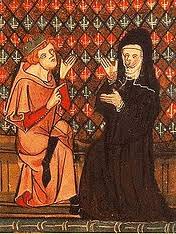
Introduction: According to a survey of medieval epistles, the four personal letters of Heloise and Abelard are by far the “most celebrated exchange of love-letters in the Middle Ages.” Taking place in twelfth century France, their story has since transcended time and space to inspire countless adaptations, novels, poems, plays, operas and even a TV movie. Scholars since Jean de Meun, Christine de Pisan and Francesco Petrarch have shown keen interests in the letters from both literary and humanist standpoints. Moreover, since the eighteenth century there has been an incessant debate among academics and historians over the authenticity and authorship of the letters. No other exchange of love letters has since achieved a comparable level of fame or generated as much controversy.
Through the centuries the images of Heloise (1101-1164) and Abelard (1079-1142) have evolved to symbolize love to those familiar with their story. Today, thousands of tourists flock to the couple’s final resting place in Paris’ Pere-Lachaise cemetery to pay tribute and homage to their love. However, on close reading of the letters, it is ‘sheer paradox’ that Heloise and Abelard have been regarded as “the incarnation of the Couple, the Lover and his Mistress.” As Regine Pernoud points out, the couple was united for only a brief period of time and there was very little evidence of disinterested love on the part of Abelard, if such means the “capacity to reach beyond the self, to transcend the very pleasures on which love feeds.” Indeed, in both his letters to Heloise and in Historia calamitatum, an autobiographical account addressed to an anonymous friend, Abelard displays very little gratia – a love freely given and based on chastity of the spirit – towards Heloise. Moreover, contrary to popular belief, Heloise’s love for Abelard was not truly unconditional, despite her willingness to renounce the world at his command.
In my study, I shall attempt to analyze the love shared by Heloise and Abelard. They desired each other, yet in their own ways they attempted to manipulate each other, during and after their time together. In fact, the letters disclose a power struggle between the two, with Abelard attempting to dominate Heloise and Heloise staging a rebellion under feigned submission.
In order to understand what motivated Heloise and Abelard in their struggle for power and control, it is paramount to examine the models of desire available to them as well as prevalent attitudes toward love, sex, and marriage during the Middle Ages.

By Hui-tzu Wendy Chen
Master’s Thesis, University of Hawaii at Manoa, 2002
Introduction: According to a survey of medieval epistles, the four personal letters of Heloise and Abelard are by far the “most celebrated exchange of love-letters in the Middle Ages.” Taking place in twelfth century France, their story has since transcended time and space to inspire countless adaptations, novels, poems, plays, operas and even a TV movie. Scholars since Jean de Meun, Christine de Pisan and Francesco Petrarch have shown keen interests in the letters from both literary and humanist standpoints. Moreover, since the eighteenth century there has been an incessant debate among academics and historians over the authenticity and authorship of the letters. No other exchange of love letters has since achieved a comparable level of fame or generated as much controversy.
Through the centuries the images of Heloise (1101-1164) and Abelard (1079-1142) have evolved to symbolize love to those familiar with their story. Today, thousands of tourists flock to the couple’s final resting place in Paris’ Pere-Lachaise cemetery to pay tribute and homage to their love. However, on close reading of the letters, it is ‘sheer paradox’ that Heloise and Abelard have been regarded as “the incarnation of the Couple, the Lover and his Mistress.” As Regine Pernoud points out, the couple was united for only a brief period of time and there was very little evidence of disinterested love on the part of Abelard, if such means the “capacity to reach beyond the self, to transcend the very pleasures on which love feeds.” Indeed, in both his letters to Heloise and in Historia calamitatum, an autobiographical account addressed to an anonymous friend, Abelard displays very little gratia – a love freely given and based on chastity of the spirit – towards Heloise. Moreover, contrary to popular belief, Heloise’s love for Abelard was not truly unconditional, despite her willingness to renounce the world at his command.
In my study, I shall attempt to analyze the love shared by Heloise and Abelard. They desired each other, yet in their own ways they attempted to manipulate each other, during and after their time together. In fact, the letters disclose a power struggle between the two, with Abelard attempting to dominate Heloise and Heloise staging a rebellion under feigned submission.
In order to understand what motivated Heloise and Abelard in their struggle for power and control, it is paramount to examine the models of desire available to them as well as prevalent attitudes toward love, sex, and marriage during the Middle Ages.
Click here to read this thesis from the University of Hawaii
Subscribe to Medievalverse
Related Posts