Between A Rock And A Hot Place: The Role Of Subjectivity In The Medieval Ordeal By Hot Iron
By Ian C. Pilarczyk
Anglo-American Law Review, Vol. 87 (1996)
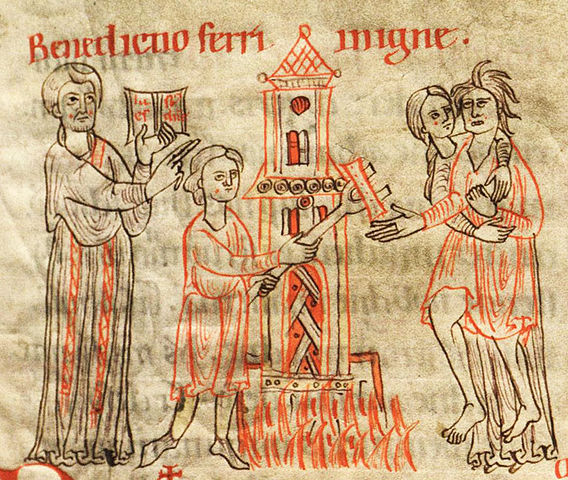
12th century depiction of an ordeal by hot iron
Abstract: Before their gradual disappearance in the Middle Ages, ordeals were used as a form of adjudication of guilt and innocence in criminal proceedings. Based on the supposition that divine knowledge and intervention would steer the results in such a way as to punish the guilty and protect the innocence, ordeals fell into disrepute after the Catholic Church banned clerical participation in 1215 A.D. This article discusses various forms of ordeals, such as the ordeal of hot iron, and analyzes whether, and to what extent, these ordeals could have served as “rational” forms of adjudication during the period.
Introduction: The ordeal played a prominent part in the adjudication of criminal matters in the early Middle Ages. Even at that time, however, the institution of the ordeal was often the subject of ardent controversy. Contemporary critics alleged that the ordeal was blasphemous as it demanded God’s intervention, or that it was simply too susceptible to human manipulation. Part I of this article discusses the ordeal and the role it played in criminal procedure. Part II addresses the ambiguities and possibilities of manipulation in the interpretative and procedural aspects of the ordeal by hot iron. Part III discusses the influence the proband could expect on the results, both consciously or unconsciously. Lastly, Part IV analyses what it means to ask if the ordeal was rational, and concludes that the ordeal could be viewed as largely rational in the context of the early Middle Ages.
Prior to the advent of the thirteenth century, the ordeals by hot and cold water, battle, and hot iron were commonplace methods of criminal procedure. Commonly referred to as Judicium Dei, the ordeals were “solemn invocation[s] to heaven to decide the matter in dispute.” The ordeal by hot iron, one of the most prevalent of the ordeals in medieval Europe, flourished in the period between 800 AD and 1200 AD before fading into obscurity, largely as a result of the Fourth Lateran Council in 1215 which prohibited clerical participation in the administration of ordeals.

Between A Rock And A Hot Place: The Role Of Subjectivity In The Medieval Ordeal By Hot Iron
By Ian C. Pilarczyk
Anglo-American Law Review, Vol. 87 (1996)
Abstract: Before their gradual disappearance in the Middle Ages, ordeals were used as a form of adjudication of guilt and innocence in criminal proceedings. Based on the supposition that divine knowledge and intervention would steer the results in such a way as to punish the guilty and protect the innocence, ordeals fell into disrepute after the Catholic Church banned clerical participation in 1215 A.D. This article discusses various forms of ordeals, such as the ordeal of hot iron, and analyzes whether, and to what extent, these ordeals could have served as “rational” forms of adjudication during the period.
Introduction: The ordeal played a prominent part in the adjudication of criminal matters in the early Middle Ages. Even at that time, however, the institution of the ordeal was often the subject of ardent controversy. Contemporary critics alleged that the ordeal was blasphemous as it demanded God’s intervention, or that it was simply too susceptible to human manipulation. Part I of this article discusses the ordeal and the role it played in criminal procedure. Part II addresses the ambiguities and possibilities of manipulation in the interpretative and procedural aspects of the ordeal by hot iron. Part III discusses the influence the proband could expect on the results, both consciously or unconsciously. Lastly, Part IV analyses what it means to ask if the ordeal was rational, and concludes that the ordeal could be viewed as largely rational in the context of the early Middle Ages.
Prior to the advent of the thirteenth century, the ordeals by hot and cold water, battle, and hot iron were commonplace methods of criminal procedure. Commonly referred to as Judicium Dei, the ordeals were “solemn invocation[s] to heaven to decide the matter in dispute.” The ordeal by hot iron, one of the most prevalent of the ordeals in medieval Europe, flourished in the period between 800 AD and 1200 AD before fading into obscurity, largely as a result of the Fourth Lateran Council in 1215 which prohibited clerical participation in the administration of ordeals.
Click here to read this article from Ian Pilarczyk’s website
Subscribe to Medievalverse
Related Posts