Impossible Recovery: Julian of Norwich and the Phenomenology of Well-Being
By Hannah Lucas
Columbia University Press
ISBN: 9780231218689
The writings of Julian of Norwich, the fourteenth-century English mystic, have long fascinated medievalists. This book zeroes in on Julian’s illness during her visions, asking what that experience was like in human terms — as the author puts it, “What did she really experience, what did she feel, there in her sickbed in 1373?”
Excerpt:
This book is about what happens when a person comes up against this glass and lives to tell the tales. It thinks about the entanglement of illness and revelation, asking how and why these phenomena seem to share so many characteristics. But most of all, the book considers the aftermath of these fracturing events: their impact on a person as well as the textual artifacts that emerge from them – how they are theorized, interpreted, and put into language. This is a book about what it means to come back from the edge of experience and the possibilities of recovery afforded by the written word.
Who is this book for?
Julian of Norwich is an important figure in mysticism, so this book will be of interest to anyone in this field and medieval Christianity more broadly. The author’s novel approach to this topic will also lure in more readers and could bring about a broader reevaluation of Julian’s Revelations of Divine Love.
“This is the most exhilarating book in medieval studies I’ve read in some time. It continues the recent recovery, to use a word of rich significance in Lucas’s book, of Julian as an important medieval and modern theologian, and presents her here as a significant phenomenologist with substantial challenges to contemporary phenomenology. This is not just an important engagement with several contemporary theoretical concerns (disability studies, medical humanities, phenomenology), nor an important reading of Julian’s Showings, but a project that couldn’t be done without all of those together. It’s a model of how to think theoretically with, in, and about the Middle Ages.” ~ review by D. Vance Smith in Studies in the Age of Chaucer
“This book is fascinating and well written, and it does a remarkable job of explaining phenomenology to a nonphenomenologist (like me). Lucas also takes care to explain the relevant medieval contexts, making her work more accessible to philosophers.” ~ review by Jessica Barr in Social History of Medicine
The Author
Hannah Lucas is a Research Fellow at both the Max Planck Institute for the History of Science and the Technische Universität Berlin. On her personal website, she describes her research as “histories of attention through medieval devotional texts, tracing connections between premodern contemplative hermeneutics and modern literary theory.”
You can learn more about this book from the publisher’s website. See also this blog post from Columbia University Press, where Hannah explains more about why she wrote this book.

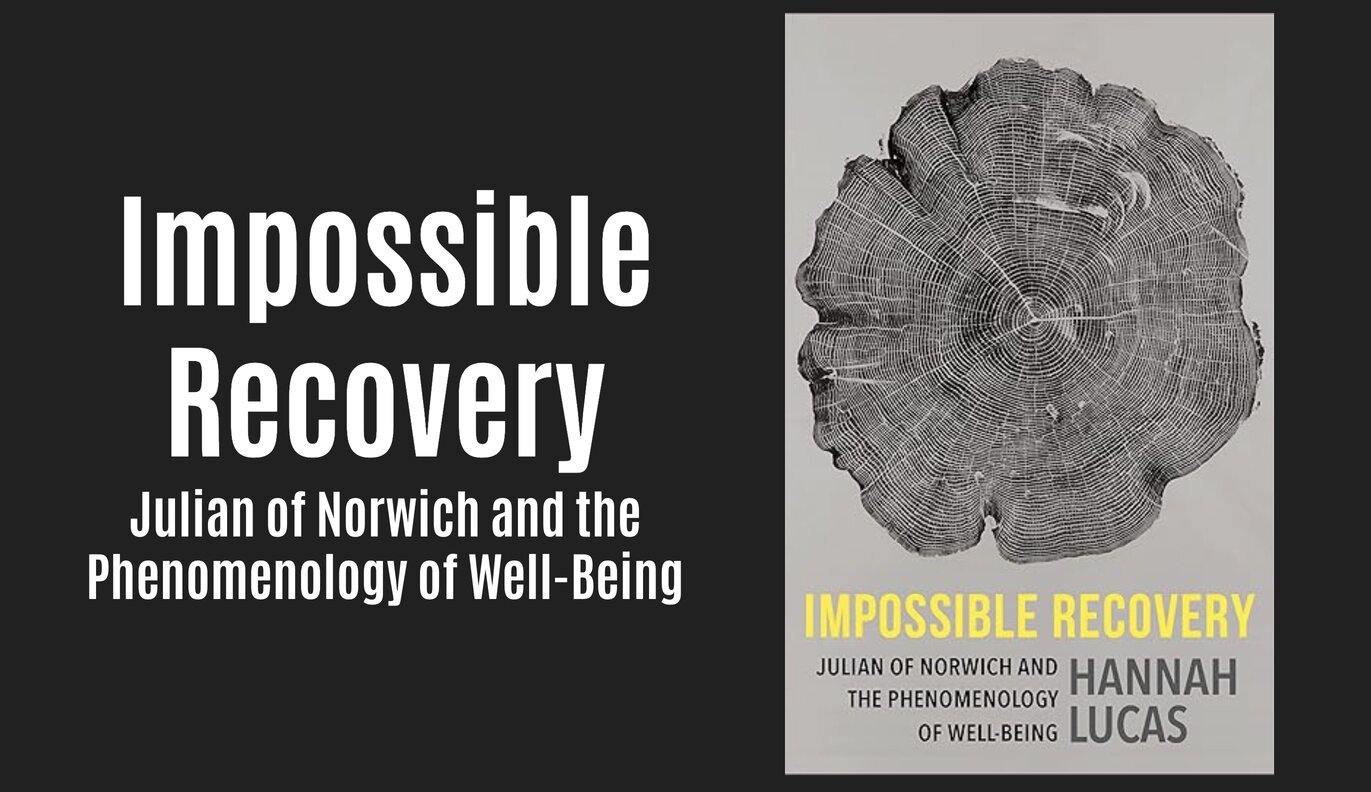
Impossible Recovery: Julian of Norwich and the Phenomenology of Well-Being
By Hannah Lucas
Columbia University Press
ISBN: 9780231218689
The writings of Julian of Norwich, the fourteenth-century English mystic, have long fascinated medievalists. This book zeroes in on Julian’s illness during her visions, asking what that experience was like in human terms — as the author puts it, “What did she really experience, what did she feel, there in her sickbed in 1373?”
Excerpt:
This book is about what happens when a person comes up against this glass and lives to tell the tales. It thinks about the entanglement of illness and revelation, asking how and why these phenomena seem to share so many characteristics. But most of all, the book considers the aftermath of these fracturing events: their impact on a person as well as the textual artifacts that emerge from them – how they are theorized, interpreted, and put into language. This is a book about what it means to come back from the edge of experience and the possibilities of recovery afforded by the written word.
Who is this book for?
Julian of Norwich is an important figure in mysticism, so this book will be of interest to anyone in this field and medieval Christianity more broadly. The author’s novel approach to this topic will also lure in more readers and could bring about a broader reevaluation of Julian’s Revelations of Divine Love.
“This is the most exhilarating book in medieval studies I’ve read in some time. It continues the recent recovery, to use a word of rich significance in Lucas’s book, of Julian as an important medieval and modern theologian, and presents her here as a significant phenomenologist with substantial challenges to contemporary phenomenology. This is not just an important engagement with several contemporary theoretical concerns (disability studies, medical humanities, phenomenology), nor an important reading of Julian’s Showings, but a project that couldn’t be done without all of those together. It’s a model of how to think theoretically with, in, and about the Middle Ages.” ~ review by D. Vance Smith in Studies in the Age of Chaucer
“This book is fascinating and well written, and it does a remarkable job of explaining phenomenology to a nonphenomenologist (like me). Lucas also takes care to explain the relevant medieval contexts, making her work more accessible to philosophers.” ~ review by Jessica Barr in Social History of Medicine
The Author
Hannah Lucas is a Research Fellow at both the Max Planck Institute for the History of Science and the Technische Universität Berlin. On her personal website, she describes her research as “histories of attention through medieval devotional texts, tracing connections between premodern contemplative hermeneutics and modern literary theory.”
You can also follow Hannah on Twitter and Instagram.
You can learn more about this book from the publisher’s website. See also this blog post from Columbia University Press, where Hannah explains more about why she wrote this book.
You can buy this book on Amazon.com | Amazon.ca | Amazon.co.uk
Subscribe to Medievalverse
Related Posts