The medieval world was multilingual, but a small number of major languages dominated communication across regions. This article explains what languages were used in the Middle Ages and how they changed over time.
To make sense of this vast linguistic landscape, we organised this as a journey across the medieval world. We begin in Europe with the languages that shaped post-Roman and medieval societies, then move through the Middle East and North Africa, before travelling east across Central Asia to India and East Asia. Along the way, you’ll see how major languages rose, spread, overlapped, and evolved over time—often existing side by side with many local languages spoken in everyday life.
Legacy of the Roman Empire
Page of text (folio 160v) from a Carolingian Gospel Book (British Library, MS Add. 11848), written in Carolingian minuscule.
At the beginning of the Middle Ages, Latin remained the dominant language of writing in western Europe and the closest thing the region had to a shared international tongue. Even after the Western Roman Empire collapsed, Latin continued to connect rulers, bishops, monasteries, and scholars across long distances, so it stayed the default choice for texts meant to circulate beyond a single community—whether that meant a royal charter, a bishop’s letter, or a manuscript copied in a monastery.
Crucially, by this point Latin was more a written language than an everyday spoken one. Full literacy was limited, and Classical Latin—the polished language of ancient authors—was usually accessible only to people with formal schooling, especially clerics and some members of the elite. For most others, Latin was something they encountered through the Church, public documents, or the educated few who could read and write it.
Over the medieval period, Latin changed in noticeable ways, while still remaining recognisably Latin. Writers introduced new vocabulary for Christian life and new institutions, and their grammar and style could be more straightforward than classical models or shaped by local habits of speech. Some authors deliberately imitated ancient standards, while others wrote a more practical, workmanlike Latin—so “medieval Latin” ranges from highly classicising to plainly functional, depending on who was writing and why.
From Latin to Romance: The Making of French, Italian, and Spanish
Marco Polo, Livre des merveilles du monde, excerpt of a 15th century French manuscript of it.
As Latin became increasingly a language of education and writing, the everyday speech of western Europe continued to drift—region by region—until it was no longer simply “Latin with an accent,” but a family of distinct Romance languages. People could still recognise shared roots across neighbouring areas, but mutual understanding became harder over time, especially as pronunciation shifted and local vocabulary piled up over generations.
In what we now call France, these changes produced multiple Romance dialects, often grouped as the langues d’oïl in the north (the ancestors of French) and Occitan in the south. Over time, one northern variety—strongly associated with royal administration and cultural influence—became increasingly dominant, and “French” gradually emerged as a more widely recognised written language alongside Latin. You can see this shift in practice in the growing use of French in legal records and literature, even while Latin remained central in many formal settings.
In Italy and Iberia, the pattern was similar but with different outcomes. Italy developed a dense patchwork of Romance vernaculars (Tuscan, Venetian, Neapolitan, and many others), with Tuscan later gaining huge prestige thanks to major writers and its association with powerful city-states—helping it become the foundation for standard Italian much later. In the Iberian Peninsula, several Romance languages developed side by side (including forms ancestral to Castilian/Spanish, Catalan, and Galician-Portuguese), shaped by shifting borders, migration, and contact among Christian, Muslim, and Jewish communities. What modern readers call “Spanish” becomes most visible when Castilian grows in status as a language of royal power and literature, increasingly used in writing alongside—and eventually in place of—Latin for many purposes.
English, Norse, and German: The Medieval Germanic Languages
Old English Martyrology – British Library MS Add MS 40165 A
While Romance languages were developing from Latin in many parts of western Europe, Germanic languages were evolving along their own paths. These languages were spoken across a wide zone—from the British Isles and Scandinavia to the Frankish and German-speaking regions—and they changed enough over the medieval period that the “old” forms can look like entirely different languages to modern readers.
In England, the main early medieval language was Old English (roughly to the 11th century), a strongly inflected Germanic language with grammatical case endings and a vocabulary that can feel unfamiliar today. After the Norman Conquest (1066), the language landscape shifted: French became dominant in elite culture for a time, and English changed quickly in sound, spelling habits, and grammar. By the later medieval period, Middle English (c. 12th–15th centuries) is much closer to modern English: many case endings have disappeared, word order becomes more important, and the vocabulary expands dramatically—especially with large numbers of French and Latin loanwords. You can see Middle English rising in everything from sermons and city records to major literary works.
Page from the Old Norse manuscript Konungs skuggsjá
Across Scandinavia, Old Norse was the shared medieval ancestor of the modern North Germanic languages (Icelandic, Norwegian, Danish, Swedish). It was spoken not only in Scandinavia but also across Norse settlements in the North Atlantic. Old Norse retained a relatively complex grammar and is preserved in a rich body of literature—especially in Iceland—while later medieval developments gradually produced more clearly separated regional languages.
Old High German from Codex Abrogans
In the regions that are now Germany, Austria, and parts of Switzerland, medieval language history is often described through stages such as Old High German (early medieval) and Middle High German (high medieval), alongside related written traditions in areas like the Low Countries. Old High German texts are relatively early and often tied to religious or educational contexts, and the language keeps many older Germanic features. Middle High German (roughly 1050–1350) is better attested and closely associated with courtly literature; compared to older forms, it shows major sound changes, evolving grammar, and a clearer sense of regional literary standards.
From the Balkans to Rus’: The Slavic Languages
Church Slavonic in the Kiev Psalter of 1397
Across eastern Europe, most people spoke Slavic languages—a big family of related languages that stretched from the Balkans all the way to the forests and river towns of what later became Russia, Ukraine, and Belarus. Over the centuries, these languages slowly grew further apart, shaping the ancestors of many modern Slavic languages, with regional differences becoming more pronounced over time.
If you travelled through the Orthodox Christian world, one language mattered especially for books and church life: Church Slavonic. It wasn’t the everyday speech of most people, but it was widely used for religious writing and helped connect communities across different Slavic regions. It also spread with the Cyrillic alphabet, which became the main script in many areas influenced by Byzantium—especially visible in liturgical manuscripts and religious texts.
In Kievan Rus’ and later Rus’ states, people spoke East Slavic varieties, while many written texts—especially religious ones—show the influence of Church Slavonic. And because this region sat between major cultural zones, travellers could run into plenty of language overlap: Latin and German to the west, Greek to the south, and Turkic-speaking peoples on the steppe. Depending on where you were, language could hint at your faith, your trading connections, or which political world you were closest to.
From Latin to Greek: The Language of Byzantium
12th-century Byzantine manuscript – Codex Basilensis A. N. IV. 2
The Byzantine Empire began as the eastern half of the Roman Empire, so Latin was originally the official language of imperial government and law. But the eastern Mediterranean had long been heavily Greek-speaking, and over time Greek replaced Latin in administration. By the early Middle Ages, Greek had become the main language you would see in government documents, education, and most public life in Byzantium, while Latin lingered mostly in certain legal traditions and in contacts with the Latin West.
The Greek of Byzantium also wasn’t exactly the Greek of ancient authors, and it wasn’t yet modern Greek either. Pronunciation and everyday grammar shifted over the centuries, and medieval writers often used newer Christian vocabulary and expressions that wouldn’t feel “classical.” At the same time, educated Byzantines admired ancient literature, so formal writing could be deliberately old-fashioned in style—meaning the Greek you read in a history or speech might sound more “ancient” than the Greek people spoke at home.
And Byzantium was never only Greek. It was a multilingual empire, especially in border regions and major trading centres. You could encounter Armenian in the east, Slavic languages in parts of the Balkans, and Syriac in some Near Eastern Christian communities, while Arabic mattered along frontier zones and in diplomacy and trade. In many places, people navigated daily life in local languages while using Greek when dealing with the state, the church hierarchy, or the wider imperial world.
Arabic: A New Common Language from Spain to Central Asia
Leaf from a medieval Arabic manuscript at the Metropolitan Museum of Art
From the 7th century onward, Arabic became one of the most important languages of the medieval world. As Islamic rule spread across the Middle East, North Africa, and into parts of Europe and Central Asia, Arabic travelled with it—first as the language of a new political and religious order, and then as a practical language for administration, scholarship, and long-distance communication. Over time, it became a shared written language across an enormous region, visible in everything from legal documents to inscriptions and learned works.
A key reason Arabic could spread so widely is that the written language stayed relatively stable, even while the way people spoke varied a lot from place to place. The Arabic used for the Qur’an and for formal writing (what many people think of as “Classical” or standard Arabic) provided a common reference point across regions. But in everyday life, people spoke regional forms of Arabic that could sound quite different in pronunciation, vocabulary, and even some grammar—so someone from Morocco and someone from Iraq might both read the same formal Arabic, yet find each other’s everyday speech harder to follow.
13th-century Syriac Gospel. British Library MS Additional 7170,
Arabic also didn’t replace earlier languages overnight. Before Arabic became dominant in many areas, Aramaic had long been a major language of the Near East, widely used in daily life and local administration. Syriac—a major literary form of Aramaic—remained especially important among Christian communities for religious writing and learning. In many places, these languages continued alongside Arabic for centuries, creating a multilingual landscape where people might hear one language at home, another in church, and encounter Arabic in wider public life.
From the Maghreb to the Swahili Coast: Africa’s Medieval Languages
Ethiopian Gospel Book – Getty Museum MS 102
Africa’s medieval language map was huge and varied, so it helps to think in regions. In North Africa, Arabic became the most widely used language in cities and long-distance communication, especially from the early medieval period onward. But it existed alongside Amazigh (Berber) languages, which remained widely spoken across the Maghreb and the Sahara (with different varieties in different areas). In many places, you’d hear Amazigh at home and in local communities, while Arabic had growing reach in public life.
Along the Nile Valley and in the Horn of Africa, older written traditions remained important. In Egypt, Coptic continued as a Christian community language (especially in religious contexts) even as Arabic became dominant more broadly. Further south, medieval Nubian kingdoms used Old Nubian in writing, while in Ethiopia and Eritrea, Geʽez served as a major written and liturgical language for Christian texts, with related living languages used in everyday life—preserved in manuscripts and church traditions.
Across West Africa and the Sahel, there wasn’t one single “African Latin” equivalent, but there were major languages that carried influence through trade, politics, and religion. As Islam spread through parts of the region, Arabic became important for learning and writing, and it was sometimes used to write local languages in Arabic script (often called Ajami). At the same time, large language families such as Mandé (used in Mali Empires), Songhay, and others shaped everyday communication across wide zones.
On the East African coast, a different multilingual world emerged, shaped by Indian Ocean connections. Swahili developed as a major coastal language (with many Arabic loanwords), while Arabic remained important for religion, scholarship, and wider networks. Inland, the continent’s linguistic diversity was even broader—so the “big” medieval languages in Africa were often regional anchors, surrounded by many local languages that never stopped thriving.
Persian: The Language of Courts and Caravan Routes
A Persian manuscript of the writings of Rumi from the Jalal al-Din Rumi (d. 1273) and the diwan of his son Baha al-Din Sultan Walad, Seljuk Anatolia, late 13th – early 14th century – Wikimedia Commons
Persian became one of the medieval world’s major “bridge” languages, especially across Iran and Central Asia, and later into parts of South Asia. Earlier forms of Persian existed in late antiquity, but in the medieval period a new written standard—often called New Persian—rose to prominence and spread widely. It became a language people used to communicate across regions, not because everyone spoke it at home, but because it became useful and prestigious in high-status settings.
One reason Persian travelled so far is that it became closely tied to court culture and administration. In many kingdoms and empires east of the Mediterranean, Persian was a language you might encounter in official correspondence, court poetry, and chronicles—especially where rulers wanted to signal sophistication and connection to older Iranian traditions. It also lived alongside Arabic, which remained especially important for religion and many scholarly fields, so bilingual worlds were common in educated circles.
Persian didn’t replace local languages across the regions where it spread. Instead, it often sat on top of a multilingual reality: Turkic languages in many steppe and military settings, Persian in elite and literary life, and a range of local languages in everyday speech. In practical terms, if you were moving along caravan routes or dealing with officials in parts of Iran and Central Asia, Persian could be one of the most useful languages to recognise—especially in writing.
Sanskrit and the Vernaculars: Languages of Medieval South Asia
12th century Balabodhini Sanskrit grammar manuscript by Kashmir Pandit Jagaddhara Bhatta, National Museum, Delhi
This region was never a single-language world—travel even short distances and you could encounter different main languages, scripts, and literary traditions. That diversity hasn’t gone away: South Asia remains one of the most multilingual regions in the world, shaped by powerful regional languages alongside a few prestige languages that travelled widely.
For much of the Middle Ages, Sanskrit remained the most important prestige language for learned writing, religion, and elite culture. It was not the everyday speech of most communities, but it mattered because it travelled: scholars, poets, and officials trained in Sanskrit could communicate across regions in a way that local speech often couldn’t. Its cultural authority also meant that many writers and courts borrowed Sanskrit vocabulary and styles even when they chose to write in local languages, including in inscriptions and learned works.
At the same time, the Middle Ages saw a major rise in regional languages as important written and literary languages in their own right. In the south, Tamil had a deep classical tradition, while Kannada, Telugu, and Malayalam developed strong medieval literatures and courtly use. Across northern and eastern South Asia, languages ancestral to Bengali and forms of Hindi/Hindavi became increasingly visible in poetry, storytelling, and religious writing meant for broader audiences. And in parts of the north, Persian could also matter in court settings—yet the linguistic reality on the ground remained deeply regional and multilingual.
China: One Written Language, Many Spoken Voices
A Chinese letter written in 1266, addressed to the “King of Japan” (日本國王) on behalf of Kublai Khan, prior to the Mongol invasions of Japan. Annotations explaining points of grammar have been added to the text, intended to aid Japanese-speaking readers.
For most of the medieval period, the biggest constant in China was the written language. Educated people used Classical Chinese for government, scholarship, and formal writing, and because Chinese characters aren’t tied to a single pronunciation, the same text could be read across the empire even when people in different regions didn’t speak the same way.
Spoken Chinese, though, was never just one language. Regional speech kept drifting over centuries, and those differences gradually became deeper—especially between northern and southern varieties—so what a traveller heard in one province could sound quite unlike what they heard in another.
Within that long process, Mandarin has its roots in northern speech that gained influence as northern capitals and official life shaped broader “common” forms of speech used across wider areas. Cantonese traces back to the Yue speech of the far south, centred on Guangzhou (Canton), which grew in regional importance as the south’s cities and trade networks expanded. So even with a shared written tradition, medieval China was already moving toward the kind of regional spoken diversity we recognise today.
East Asia: Writing with Chinese Characters, Speaking Local Languages
Japanese manuscript from the year 1203 – Wikimedia Commons
Across medieval East Asia, Chinese influence was strongest in writing. For centuries, Classical Chinese functioned as the region’s prestige written language for government, scholarship, diplomacy, and record-keeping—even in places where nobody spoke Chinese as their native language. That meant an educated official in Japan or Korea could read and write in Classical Chinese for formal purposes while speaking a completely different language at home.
In Japan, early writing relied heavily on Chinese characters (kanji), but Japanese grammar is very different from Chinese, so scribes developed ways to make the characters fit Japanese speech. By the 9th century, Japanese writers were producing major works in a written form closer to Japanese speech, while Classical Chinese-style writing still remained important for official and scholarly contexts.
In Korea, Chinese characters (hanja) dominated formal writing for much of the medieval period, and educated elites used Classical Chinese extensively. But Koreans also created specialised systems to represent Korean using Chinese characters in Korean word order and grammar. A major shift ctook place in the 15th century, when the Joseon court created Hangul, a phonetic alphabet designed to write Korean more directly—though Classical Chinese and hanja continued to matter for elite writing for a long time afterward.
Elsewhere in East Asia, the pattern repeats with local twists. In Vietnam, Classical Chinese was the language of government and scholarship for centuries, while Vietnamese developed chữ Nôm, a character-based system adapted to write Vietnamese. Across frontier and steppe regions (like the Liao, Jin, and Western Xia worlds), states also created their own scripts (such as Khitan, Jurchen, and Tangut) alongside Chinese writing. So if you travelled through medieval East Asia, you’d repeatedly see the same divide: a shared, China-linked written culture at the top, and deeply local spoken languages shaping everyday life.
The Steppe: Turkic and Mongol Worlds on the Move
Old Turkic manuscript from the 9th century
Across the great Eurasian Steppe—from the Black Sea to Mongolia—language was shaped by mobility. Steppe empires and confederations linked huge distances through diplomacy, war, and trade, and travellers often encountered Turkic languages as some of the most widespread spoken tongues. Different Turkic groups spoke different varieties, but they were part of a broad family that could carry people across vast corridors, especially as Turkic-speaking powers rose across Central Asia and interacted with settled empires to the south.
The Mongol expansions of the 13th century added another major layer. Mongolian became politically important across a massive imperial network, and Mongol rulers governed multilingual populations from China to the Middle East and eastern Europe. Even within Mongol-ruled territories, though, day-to-day communication often remained local—so Mongolian influence sat alongside Turkic languages in the steppe, and alongside Persian, Chinese, and many others in settled regions.
Because the steppe connected so many worlds, it also produced constant multilingual contact. Merchants, envoys, and soldiers moved between languages, and empires relied on translators and mixed communities at frontier towns and caravan routes. Written records could shift by region as well—Mongol-era decrees, letters, and accounts might appear in different major languages depending on where you were in the empire. In practical terms, the steppe was less about one “steppe language” and more about overlapping lingua francas—Turkic languages in many settings, Mongolian at the height of Mongol power, and whatever major written languages dominated the neighbouring settled empires.
Other Medieval Languages You Would Encounter
Cairo Genizah document from the year 1135
Even after the biggest cross-regional languages, the medieval world was full of other important tongues—some tied to strong regional cultures, others to long-distance trade or tight-knit communities. In western Europe, travellers could still encounter Celtic languages such as Irish, Welsh, and Breton alongside Romance and Germanic neighbours. In northern Iberia, Basque persisted as a distinctive local language, unrelated to the surrounding Romance languages, and it remained part of the region’s everyday linguistic landscape.
Around the eastern Mediterranean and the Caucasus, major communities used languages with long written traditions of their own, including Armenian and Georgian. Further north and east, travellers could meet speakers of Finno-Ugric languages—ancestors of Finnish and Estonian—living alongside Scandinavian and Slavic neighbours, especially in border regions where people often picked up more than one language to get by.
Some languages also travelled because communities carried them across borders. Hebrew, for example, was widely used for Jewish religious and scholarly life across the medieval world, even when everyday conversation took place in whatever local language was spoken around them. The takeaway is that “major languages” helped people travel far, but they never replaced the dense web of regional and community languages that shaped daily life everywhere.

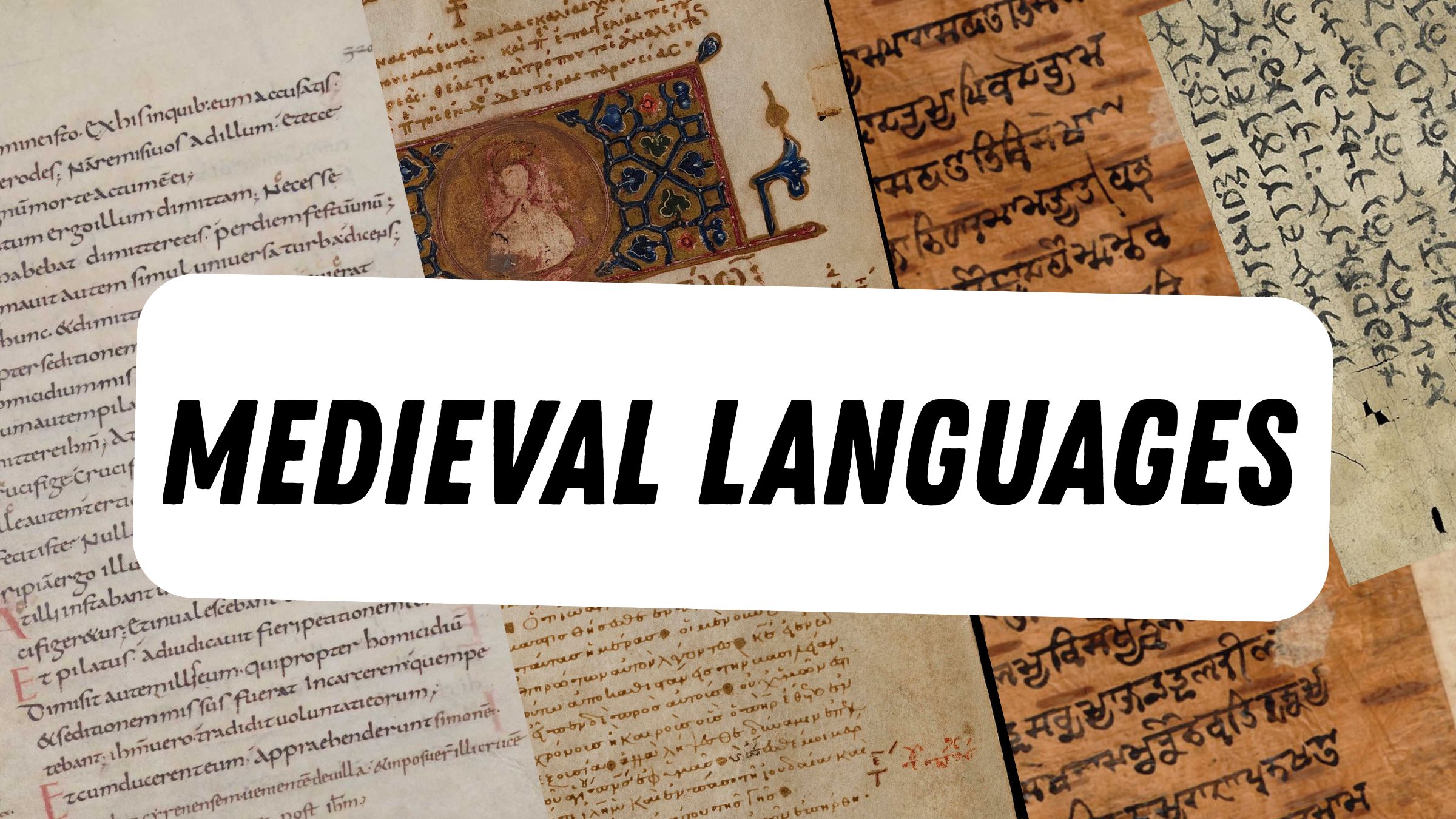
The medieval world was multilingual, but a small number of major languages dominated communication across regions. This article explains what languages were used in the Middle Ages and how they changed over time.
To make sense of this vast linguistic landscape, we organised this as a journey across the medieval world. We begin in Europe with the languages that shaped post-Roman and medieval societies, then move through the Middle East and North Africa, before travelling east across Central Asia to India and East Asia. Along the way, you’ll see how major languages rose, spread, overlapped, and evolved over time—often existing side by side with many local languages spoken in everyday life.
Legacy of the Roman Empire
At the beginning of the Middle Ages, Latin remained the dominant language of writing in western Europe and the closest thing the region had to a shared international tongue. Even after the Western Roman Empire collapsed, Latin continued to connect rulers, bishops, monasteries, and scholars across long distances, so it stayed the default choice for texts meant to circulate beyond a single community—whether that meant a royal charter, a bishop’s letter, or a manuscript copied in a monastery.
Crucially, by this point Latin was more a written language than an everyday spoken one. Full literacy was limited, and Classical Latin—the polished language of ancient authors—was usually accessible only to people with formal schooling, especially clerics and some members of the elite. For most others, Latin was something they encountered through the Church, public documents, or the educated few who could read and write it.
Over the medieval period, Latin changed in noticeable ways, while still remaining recognisably Latin. Writers introduced new vocabulary for Christian life and new institutions, and their grammar and style could be more straightforward than classical models or shaped by local habits of speech. Some authors deliberately imitated ancient standards, while others wrote a more practical, workmanlike Latin—so “medieval Latin” ranges from highly classicising to plainly functional, depending on who was writing and why.
From Latin to Romance: The Making of French, Italian, and Spanish
As Latin became increasingly a language of education and writing, the everyday speech of western Europe continued to drift—region by region—until it was no longer simply “Latin with an accent,” but a family of distinct Romance languages. People could still recognise shared roots across neighbouring areas, but mutual understanding became harder over time, especially as pronunciation shifted and local vocabulary piled up over generations.
In what we now call France, these changes produced multiple Romance dialects, often grouped as the langues d’oïl in the north (the ancestors of French) and Occitan in the south. Over time, one northern variety—strongly associated with royal administration and cultural influence—became increasingly dominant, and “French” gradually emerged as a more widely recognised written language alongside Latin. You can see this shift in practice in the growing use of French in legal records and literature, even while Latin remained central in many formal settings.
In Italy and Iberia, the pattern was similar but with different outcomes. Italy developed a dense patchwork of Romance vernaculars (Tuscan, Venetian, Neapolitan, and many others), with Tuscan later gaining huge prestige thanks to major writers and its association with powerful city-states—helping it become the foundation for standard Italian much later. In the Iberian Peninsula, several Romance languages developed side by side (including forms ancestral to Castilian/Spanish, Catalan, and Galician-Portuguese), shaped by shifting borders, migration, and contact among Christian, Muslim, and Jewish communities. What modern readers call “Spanish” becomes most visible when Castilian grows in status as a language of royal power and literature, increasingly used in writing alongside—and eventually in place of—Latin for many purposes.
English, Norse, and German: The Medieval Germanic Languages
While Romance languages were developing from Latin in many parts of western Europe, Germanic languages were evolving along their own paths. These languages were spoken across a wide zone—from the British Isles and Scandinavia to the Frankish and German-speaking regions—and they changed enough over the medieval period that the “old” forms can look like entirely different languages to modern readers.
In England, the main early medieval language was Old English (roughly to the 11th century), a strongly inflected Germanic language with grammatical case endings and a vocabulary that can feel unfamiliar today. After the Norman Conquest (1066), the language landscape shifted: French became dominant in elite culture for a time, and English changed quickly in sound, spelling habits, and grammar. By the later medieval period, Middle English (c. 12th–15th centuries) is much closer to modern English: many case endings have disappeared, word order becomes more important, and the vocabulary expands dramatically—especially with large numbers of French and Latin loanwords. You can see Middle English rising in everything from sermons and city records to major literary works.
Across Scandinavia, Old Norse was the shared medieval ancestor of the modern North Germanic languages (Icelandic, Norwegian, Danish, Swedish). It was spoken not only in Scandinavia but also across Norse settlements in the North Atlantic. Old Norse retained a relatively complex grammar and is preserved in a rich body of literature—especially in Iceland—while later medieval developments gradually produced more clearly separated regional languages.
In the regions that are now Germany, Austria, and parts of Switzerland, medieval language history is often described through stages such as Old High German (early medieval) and Middle High German (high medieval), alongside related written traditions in areas like the Low Countries. Old High German texts are relatively early and often tied to religious or educational contexts, and the language keeps many older Germanic features. Middle High German (roughly 1050–1350) is better attested and closely associated with courtly literature; compared to older forms, it shows major sound changes, evolving grammar, and a clearer sense of regional literary standards.
From the Balkans to Rus’: The Slavic Languages
Across eastern Europe, most people spoke Slavic languages—a big family of related languages that stretched from the Balkans all the way to the forests and river towns of what later became Russia, Ukraine, and Belarus. Over the centuries, these languages slowly grew further apart, shaping the ancestors of many modern Slavic languages, with regional differences becoming more pronounced over time.
If you travelled through the Orthodox Christian world, one language mattered especially for books and church life: Church Slavonic. It wasn’t the everyday speech of most people, but it was widely used for religious writing and helped connect communities across different Slavic regions. It also spread with the Cyrillic alphabet, which became the main script in many areas influenced by Byzantium—especially visible in liturgical manuscripts and religious texts.
In Kievan Rus’ and later Rus’ states, people spoke East Slavic varieties, while many written texts—especially religious ones—show the influence of Church Slavonic. And because this region sat between major cultural zones, travellers could run into plenty of language overlap: Latin and German to the west, Greek to the south, and Turkic-speaking peoples on the steppe. Depending on where you were, language could hint at your faith, your trading connections, or which political world you were closest to.
From Latin to Greek: The Language of Byzantium
The Byzantine Empire began as the eastern half of the Roman Empire, so Latin was originally the official language of imperial government and law. But the eastern Mediterranean had long been heavily Greek-speaking, and over time Greek replaced Latin in administration. By the early Middle Ages, Greek had become the main language you would see in government documents, education, and most public life in Byzantium, while Latin lingered mostly in certain legal traditions and in contacts with the Latin West.
The Greek of Byzantium also wasn’t exactly the Greek of ancient authors, and it wasn’t yet modern Greek either. Pronunciation and everyday grammar shifted over the centuries, and medieval writers often used newer Christian vocabulary and expressions that wouldn’t feel “classical.” At the same time, educated Byzantines admired ancient literature, so formal writing could be deliberately old-fashioned in style—meaning the Greek you read in a history or speech might sound more “ancient” than the Greek people spoke at home.
And Byzantium was never only Greek. It was a multilingual empire, especially in border regions and major trading centres. You could encounter Armenian in the east, Slavic languages in parts of the Balkans, and Syriac in some Near Eastern Christian communities, while Arabic mattered along frontier zones and in diplomacy and trade. In many places, people navigated daily life in local languages while using Greek when dealing with the state, the church hierarchy, or the wider imperial world.
Arabic: A New Common Language from Spain to Central Asia
Metropolitan Museum of Art
From the 7th century onward, Arabic became one of the most important languages of the medieval world. As Islamic rule spread across the Middle East, North Africa, and into parts of Europe and Central Asia, Arabic travelled with it—first as the language of a new political and religious order, and then as a practical language for administration, scholarship, and long-distance communication. Over time, it became a shared written language across an enormous region, visible in everything from legal documents to inscriptions and learned works.
A key reason Arabic could spread so widely is that the written language stayed relatively stable, even while the way people spoke varied a lot from place to place. The Arabic used for the Qur’an and for formal writing (what many people think of as “Classical” or standard Arabic) provided a common reference point across regions. But in everyday life, people spoke regional forms of Arabic that could sound quite different in pronunciation, vocabulary, and even some grammar—so someone from Morocco and someone from Iraq might both read the same formal Arabic, yet find each other’s everyday speech harder to follow.
Arabic also didn’t replace earlier languages overnight. Before Arabic became dominant in many areas, Aramaic had long been a major language of the Near East, widely used in daily life and local administration. Syriac—a major literary form of Aramaic—remained especially important among Christian communities for religious writing and learning. In many places, these languages continued alongside Arabic for centuries, creating a multilingual landscape where people might hear one language at home, another in church, and encounter Arabic in wider public life.
From the Maghreb to the Swahili Coast: Africa’s Medieval Languages
Africa’s medieval language map was huge and varied, so it helps to think in regions. In North Africa, Arabic became the most widely used language in cities and long-distance communication, especially from the early medieval period onward. But it existed alongside Amazigh (Berber) languages, which remained widely spoken across the Maghreb and the Sahara (with different varieties in different areas). In many places, you’d hear Amazigh at home and in local communities, while Arabic had growing reach in public life.
Along the Nile Valley and in the Horn of Africa, older written traditions remained important. In Egypt, Coptic continued as a Christian community language (especially in religious contexts) even as Arabic became dominant more broadly. Further south, medieval Nubian kingdoms used Old Nubian in writing, while in Ethiopia and Eritrea, Geʽez served as a major written and liturgical language for Christian texts, with related living languages used in everyday life—preserved in manuscripts and church traditions.
Across West Africa and the Sahel, there wasn’t one single “African Latin” equivalent, but there were major languages that carried influence through trade, politics, and religion. As Islam spread through parts of the region, Arabic became important for learning and writing, and it was sometimes used to write local languages in Arabic script (often called Ajami). At the same time, large language families such as Mandé (used in Mali Empires), Songhay, and others shaped everyday communication across wide zones.
On the East African coast, a different multilingual world emerged, shaped by Indian Ocean connections. Swahili developed as a major coastal language (with many Arabic loanwords), while Arabic remained important for religion, scholarship, and wider networks. Inland, the continent’s linguistic diversity was even broader—so the “big” medieval languages in Africa were often regional anchors, surrounded by many local languages that never stopped thriving.
Persian: The Language of Courts and Caravan Routes
Persian became one of the medieval world’s major “bridge” languages, especially across Iran and Central Asia, and later into parts of South Asia. Earlier forms of Persian existed in late antiquity, but in the medieval period a new written standard—often called New Persian—rose to prominence and spread widely. It became a language people used to communicate across regions, not because everyone spoke it at home, but because it became useful and prestigious in high-status settings.
One reason Persian travelled so far is that it became closely tied to court culture and administration. In many kingdoms and empires east of the Mediterranean, Persian was a language you might encounter in official correspondence, court poetry, and chronicles—especially where rulers wanted to signal sophistication and connection to older Iranian traditions. It also lived alongside Arabic, which remained especially important for religion and many scholarly fields, so bilingual worlds were common in educated circles.
Persian didn’t replace local languages across the regions where it spread. Instead, it often sat on top of a multilingual reality: Turkic languages in many steppe and military settings, Persian in elite and literary life, and a range of local languages in everyday speech. In practical terms, if you were moving along caravan routes or dealing with officials in parts of Iran and Central Asia, Persian could be one of the most useful languages to recognise—especially in writing.
Sanskrit and the Vernaculars: Languages of Medieval South Asia
This region was never a single-language world—travel even short distances and you could encounter different main languages, scripts, and literary traditions. That diversity hasn’t gone away: South Asia remains one of the most multilingual regions in the world, shaped by powerful regional languages alongside a few prestige languages that travelled widely.
For much of the Middle Ages, Sanskrit remained the most important prestige language for learned writing, religion, and elite culture. It was not the everyday speech of most communities, but it mattered because it travelled: scholars, poets, and officials trained in Sanskrit could communicate across regions in a way that local speech often couldn’t. Its cultural authority also meant that many writers and courts borrowed Sanskrit vocabulary and styles even when they chose to write in local languages, including in inscriptions and learned works.
At the same time, the Middle Ages saw a major rise in regional languages as important written and literary languages in their own right. In the south, Tamil had a deep classical tradition, while Kannada, Telugu, and Malayalam developed strong medieval literatures and courtly use. Across northern and eastern South Asia, languages ancestral to Bengali and forms of Hindi/Hindavi became increasingly visible in poetry, storytelling, and religious writing meant for broader audiences. And in parts of the north, Persian could also matter in court settings—yet the linguistic reality on the ground remained deeply regional and multilingual.
China: One Written Language, Many Spoken Voices
For most of the medieval period, the biggest constant in China was the written language. Educated people used Classical Chinese for government, scholarship, and formal writing, and because Chinese characters aren’t tied to a single pronunciation, the same text could be read across the empire even when people in different regions didn’t speak the same way.
Spoken Chinese, though, was never just one language. Regional speech kept drifting over centuries, and those differences gradually became deeper—especially between northern and southern varieties—so what a traveller heard in one province could sound quite unlike what they heard in another.
Within that long process, Mandarin has its roots in northern speech that gained influence as northern capitals and official life shaped broader “common” forms of speech used across wider areas. Cantonese traces back to the Yue speech of the far south, centred on Guangzhou (Canton), which grew in regional importance as the south’s cities and trade networks expanded. So even with a shared written tradition, medieval China was already moving toward the kind of regional spoken diversity we recognise today.
East Asia: Writing with Chinese Characters, Speaking Local Languages
Across medieval East Asia, Chinese influence was strongest in writing. For centuries, Classical Chinese functioned as the region’s prestige written language for government, scholarship, diplomacy, and record-keeping—even in places where nobody spoke Chinese as their native language. That meant an educated official in Japan or Korea could read and write in Classical Chinese for formal purposes while speaking a completely different language at home.
In Japan, early writing relied heavily on Chinese characters (kanji), but Japanese grammar is very different from Chinese, so scribes developed ways to make the characters fit Japanese speech. By the 9th century, Japanese writers were producing major works in a written form closer to Japanese speech, while Classical Chinese-style writing still remained important for official and scholarly contexts.
In Korea, Chinese characters (hanja) dominated formal writing for much of the medieval period, and educated elites used Classical Chinese extensively. But Koreans also created specialised systems to represent Korean using Chinese characters in Korean word order and grammar. A major shift ctook place in the 15th century, when the Joseon court created Hangul, a phonetic alphabet designed to write Korean more directly—though Classical Chinese and hanja continued to matter for elite writing for a long time afterward.
Elsewhere in East Asia, the pattern repeats with local twists. In Vietnam, Classical Chinese was the language of government and scholarship for centuries, while Vietnamese developed chữ Nôm, a character-based system adapted to write Vietnamese. Across frontier and steppe regions (like the Liao, Jin, and Western Xia worlds), states also created their own scripts (such as Khitan, Jurchen, and Tangut) alongside Chinese writing. So if you travelled through medieval East Asia, you’d repeatedly see the same divide: a shared, China-linked written culture at the top, and deeply local spoken languages shaping everyday life.
The Steppe: Turkic and Mongol Worlds on the Move
Across the great Eurasian Steppe—from the Black Sea to Mongolia—language was shaped by mobility. Steppe empires and confederations linked huge distances through diplomacy, war, and trade, and travellers often encountered Turkic languages as some of the most widespread spoken tongues. Different Turkic groups spoke different varieties, but they were part of a broad family that could carry people across vast corridors, especially as Turkic-speaking powers rose across Central Asia and interacted with settled empires to the south.
The Mongol expansions of the 13th century added another major layer. Mongolian became politically important across a massive imperial network, and Mongol rulers governed multilingual populations from China to the Middle East and eastern Europe. Even within Mongol-ruled territories, though, day-to-day communication often remained local—so Mongolian influence sat alongside Turkic languages in the steppe, and alongside Persian, Chinese, and many others in settled regions.
Because the steppe connected so many worlds, it also produced constant multilingual contact. Merchants, envoys, and soldiers moved between languages, and empires relied on translators and mixed communities at frontier towns and caravan routes. Written records could shift by region as well—Mongol-era decrees, letters, and accounts might appear in different major languages depending on where you were in the empire. In practical terms, the steppe was less about one “steppe language” and more about overlapping lingua francas—Turkic languages in many settings, Mongolian at the height of Mongol power, and whatever major written languages dominated the neighbouring settled empires.
Other Medieval Languages You Would Encounter
Even after the biggest cross-regional languages, the medieval world was full of other important tongues—some tied to strong regional cultures, others to long-distance trade or tight-knit communities. In western Europe, travellers could still encounter Celtic languages such as Irish, Welsh, and Breton alongside Romance and Germanic neighbours. In northern Iberia, Basque persisted as a distinctive local language, unrelated to the surrounding Romance languages, and it remained part of the region’s everyday linguistic landscape.
Around the eastern Mediterranean and the Caucasus, major communities used languages with long written traditions of their own, including Armenian and Georgian. Further north and east, travellers could meet speakers of Finno-Ugric languages—ancestors of Finnish and Estonian—living alongside Scandinavian and Slavic neighbours, especially in border regions where people often picked up more than one language to get by.
Some languages also travelled because communities carried them across borders. Hebrew, for example, was widely used for Jewish religious and scholarly life across the medieval world, even when everyday conversation took place in whatever local language was spoken around them. The takeaway is that “major languages” helped people travel far, but they never replaced the dense web of regional and community languages that shaped daily life everywhere.
Click here to learn more about Languages in the Middle Ages
Subscribe to Medievalverse
Related Posts