What’s new in medieval studies? Here are ten open-access articles published in November, which include papers ranging from bee amulets to the Stone of Scone.
This ongoing series on Medievalists.net highlights what has been published in journals over the last month that deal with the Middle Ages. All ten articles are Open-Access, meaning you can read them for free. We have a special tier on our Patreon where you can see the full list of the 72 open-access articles we found.
A Register of Debts Owed to Jews, Confiscated in 1349: What it Tells Us about Moneylending Practices
By Christoph Cluse
Aschkenas
Abstract: This article deals with two registers of outstanding loans contracted with Jewish moneylenders in the town of Mons and its surroundings (county of Hainaut). They were drawn up in the course of the persecutions at the time of the Black Death, during the summer of 1349. It is claimed that the registers, at least in part, constitute translations from the Hebrew account books kept by the moneylenders themselves. Where they give details, they allow insights into the Jews’ accounting practices, offering rare additions to what we know from the few extant Hebrew account books of the later medieval period. This concerns, inter alia, the practice of calculating interest. Given the short-term nature of the loan contracts, compound interest could accrue.
Life in pieces: lessons in the value of fragments from the secret lives of the Stone of Scone / Destiny
By Sally Foster
The Antiquaries Journal
Abstract: This study identifies, introduces and joins up the long lives of the geographically dispersed fragments that exist of the famed and fabled Stone of Scone/Destiny, used in inauguration and coronation of Scottish, English and British monarchs since medieval times. Based on an interdisciplinary approach that combines material culture studies and ethnographic methods, it characterises the networks in which the fragments have lived and considers what work these fragments were and are doing. It asks what difference fragmentation and the existence of fragments makes to our contemporary understanding of the meaning, values and significance of the Stone. The Stone and its considerable fragmentation evoke specific procedural and curatorial issues that invite wider reflection on the nature and role of fragments, and about private collections and their afterlives. Through the life of pieces, the study suggests, we can better understand what role social value could and should be playing in our museum and heritage practices.
Do National Histories Affect National Identities? Ancient Athens, Byzantium and Greece Today, a Survey Experiment
By Peter Gries, Stefanos Kordosis and Richard Turcsányi
Nations and Nationalism
Abstract: Do national histories affect national identities? Most nations have complex and multiple pasts. Nationalist historians can smooth over discontinuities by either merging them into an unbroken national narrative or by skipping over pasts that do not fit the story. This study explores the Greek case: the ‘Helleno-Christian’ synthesis dominant since the 1850s. Do distinct ancient Greek and Byzantine pasts persist in Greece today, differentially affecting co-existing Democratic and Christian Greek national identities in the present? Or have these pasts fused into one?
In a survey experiment, we found that Greeks randomly assigned to read an imitation Wikipedia entry about Ancient Greece (vs. Byzantium) were more likely to endorse a Democratic Greek national identity in the present, while pre-existing progressive Left-to-conservative Right ideologies moderated the impact of the two histories on a Christian Greek national identity today. The mutual constitution of the past and present of nations is then further discussed.
The Common Good: Military Service as Community Organisation in the Carolingian World
By Christoph Haack
Journal of Medieval History
Abstract: The Carolingian empire under Charlemagne (768–814) and Louis the Pious (814– 840) was a polity deeply shaped by war, or, more specifically, the organisation of warfare. Taking the – for its time – extremely efficient military organisation of this polity as a case study, the article seeks to further recent understandings of early medieval governance. Ultimately, it asks for the ‘state without the state’. Its starting point is the paradox of the simultaneous sophistication and alterity of Carolingian military organisation. This has to be understood as one element of a specific form of governance that looks very alien to the eyes of a modern observer but still effectively provided ‘public goods’ like, among others, effective military forces. It was characterised by the intertwinement of personal and formal components that interrelated to a form of transpersonal polity – which was framed as the ‘public good’, the res publica.
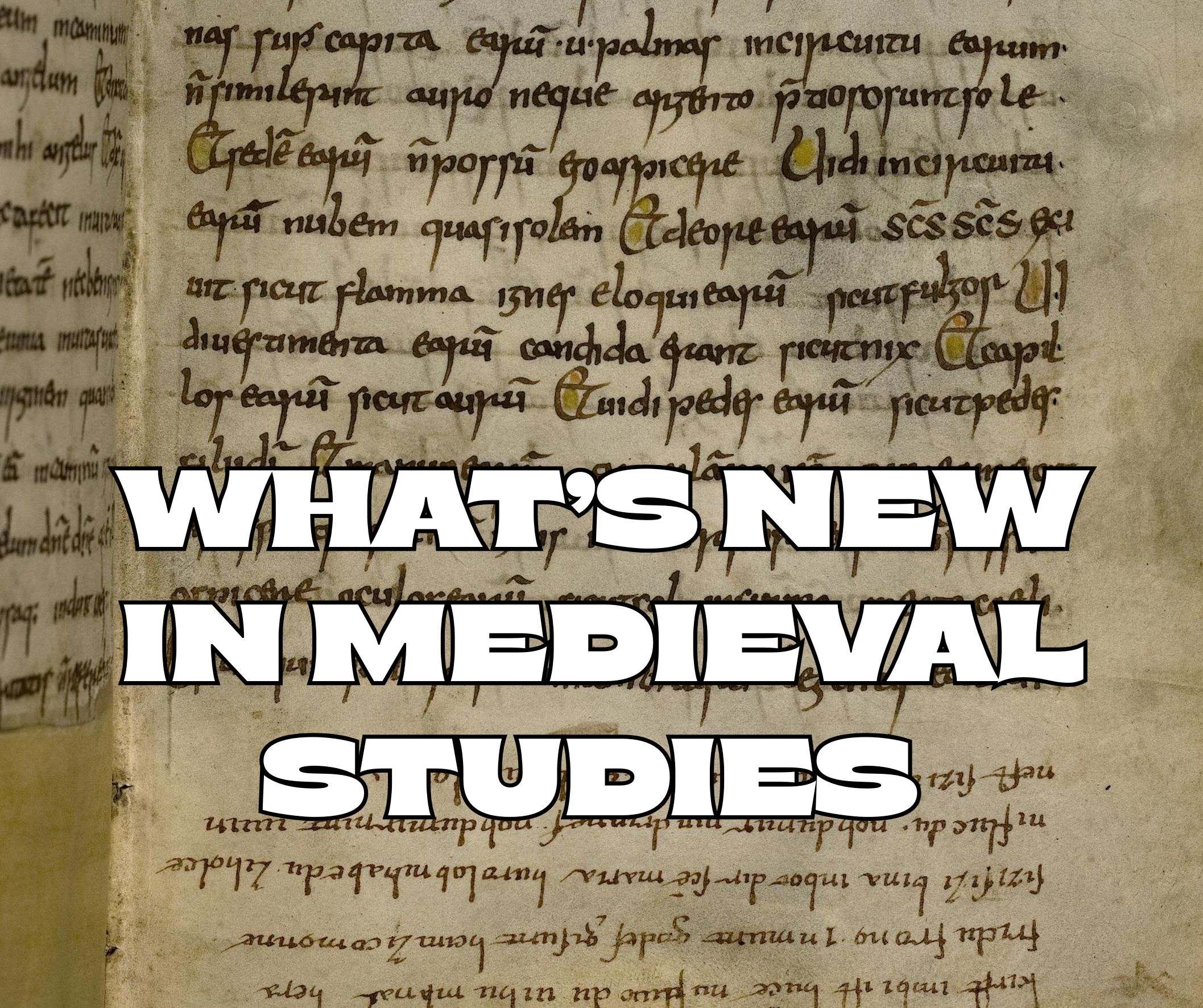
The Lorscher Bienensegen is an Amulet: Using Manuscript Margins to Make Amulets
By Tim Hertogh
Manuscript and Text Cultures
Abstract: The Old High German Lorscher Bienensegen or Lorsch bee incantation is one of the best-known examples of a text that uses the power of words to influence the behaviour of bees. During the tenth century, this text was written upside down in the margins of the ninth-century manuscript Vatican, Cod. Pal. Lat. 220. It has long been assumed that the text is a written version of an oral tradition that was recited by beekeepers in and around the abbey of Lorsch. However, this raises the question of why someone would write such a text upside down in the margins of an older manuscript.
Contrary to previous scholarship, I propose that the Lorsch bee incantation was intended to be used as an amulet which was to be placed in an apiary. To make this argument, I will first discuss other Bienensegen, several of which explicitly instruct their readers to write down the text to prevent bees from fleeing. Second, I will demonstrate that in the manuscript that contains the incantation numerous parts of the margins were cut out. Thereby, I will suggest that the resulting strips of parchment could have been used to produce amulets. In short, I will argue that the Lorscher Bienensegen is an amulet.
Hydroclimatic instability accelerated the socio-political decline of the Tang Dynasty in northern China
By M. Kempf, M. L. C. Depaermentier, R. N. Spengler III, M. D. Frachetti, F. Chen, J. Luterbacher, E. Xoplaki and U. Büntgen
Communications Earth & Environment
Abstract: Extreme flooding and prolonged, intensifying droughts have played a critical role in the rise and collapse of preindustrial states and empires worldwide, triggering cascading impacts such as crop failure, famine, and migration that undermined socio-political stability and economic resilience. We present a multicomponent hydroclimatic vulnerability model for crop supply networks to estimate the contribution of climatic stressors as one of several factors contributing to the decline of the late Tang Dynasty in northern China between 800 and 907 CE.
We demonstrate that recurrent flooding and prolonged droughts, combined with an unsustainable shift in crop production from drought-tolerant millet to less resilient wheat and rice, led to harvest failures and food shortages during the cooler and drier climatic conditions of the late 9th and early 10th centuries CE. Intensifying raiding from competing polities and climatic extremes further affected grain supplies for the late Tang’s northern military frontier and partly contributed to the sudden decline of the dynasty. Our results emphasize the importance of multicomponent environmental response models to understand historical transformations and provide new aspects of China’s socio-political development during medieval times.
A “Documentary Turn” in the Medieval History of Egypt and Syria?
By Daisy Livingston
History Compass
Abstract: The field of medieval Middle East history has seen a renewed attention to the use of documentary sources in recent years. These sources have long seen some neglect, and their interpretation has suffered from a stubborn narrative of paucity that has tended to relegate them to the fringe of this history. With the impact of other scholarly trends in the historical field at large, such as the “archival turn” and an emphasis on materiality, they are now being revisited with new and creative approaches. This article outlines this “documentary turn” in the medieval history of Egypt and Syria, focusing on three scholarly approaches which may have special potential and import for the field: the rejuvenation of history “from below,” the foregrounding of the lives of documents themselves, and the discovery of “new” document corpora.
Mills and society in early medieval northern Italy
By Marco Panato
Early Medieval Europe
Abstract: Drawing on the extensive documentary record of northern Italy, available archaeological evidence, and comparative case studies from early medieval Europe, this study demonstrates that mill-based landscapes in the Po and Friuli-Venetian plains were shaped by society as a whole. Italian charters from the late ninth and tenth centuries highlight the pivotal role of kings and emperors in managing mills and milling resources, alongside ecclesiastical and secular landlords, aristocratic women, and wealthy peasants. This article explores the varied forms and functions of mills, highlighting that, beyond their crucial role in ecological sustainability, they also served as powerful social instruments for establishing authority, consolidating alliances, and controlling territory.
Analyzing spelling patterns in the manuscripts of the tales of Canterbury
By Peter M W Robinson and Tiago Tresoldi
Digital Scholarship in the Humanities
Abstract: or decades, scholars have suggested that analysis of spellings in medieval European manuscripts might be useful in understanding who wrote the manuscripts and where and when they were written. The increased availability of full-text transcripts of manuscripts is creating larger sets of data and has opened the possibility of using quantitative methods. This article reports on analysis of spellings in manuscripts of Geoffrey Chaucer’s Book of the Tales of Canterbury. The analysis was successful in confirming long-held beliefs, based on traditional paleography, that multiple manuscripts can be identified as written by the same scribe: these manuscripts are closely aligned in their spelling patterns. Further, the analysis showed that manuscripts written by the same scribes might be closely aligned in spellings even though they are copied from exemplars with significantly different texts.
The analysis also suggested some unexpected linkages among the manuscripts, which found support in examination of the text in those manuscripts. Three sets of spelling data were submitted to the analysis: one set with all spellings assigned to regularized forms; a second with spellings sorted by headword and part-of-speech; a third with completely unsorted “bags of words” for each document. While the more structured data did yield more granular results, these gains seemed relatively slight compared to the extra effort required to create the data.
Disability in medieval Poulton (Cheshire): A case of hand amputation
By Satu Valoriani, Megan King and Kevin Cootes
International Journal of Paleopathology
Abstract: Amputations are rarely identified in the British archaeological record from the Middle Ages, with survival following hand removal particularly uncommon. This study presents a case of a healed left-hand amputation from the medieval cemetery at Poulton (Cheshire).
We found 72 open-access articles from November – you can get the full list by joining our Patreon – look for the tier that says Open Access articles in Medieval Studies.

What’s new in medieval studies? Here are ten open-access articles published in November, which include papers ranging from bee amulets to the Stone of Scone.
This ongoing series on Medievalists.net highlights what has been published in journals over the last month that deal with the Middle Ages. All ten articles are Open-Access, meaning you can read them for free. We have a special tier on our Patreon where you can see the full list of the 72 open-access articles we found.
A Register of Debts Owed to Jews, Confiscated in 1349: What it Tells Us about Moneylending Practices
By Christoph Cluse
Aschkenas
Abstract: This article deals with two registers of outstanding loans contracted with Jewish moneylenders in the town of Mons and its surroundings (county of Hainaut). They were drawn up in the course of the persecutions at the time of the Black Death, during the summer of 1349. It is claimed that the registers, at least in part, constitute translations from the Hebrew account books kept by the moneylenders themselves. Where they give details, they allow insights into the Jews’ accounting practices, offering rare additions to what we know from the few extant Hebrew account books of the later medieval period. This concerns, inter alia, the practice of calculating interest. Given the short-term nature of the loan contracts, compound interest could accrue.
Click here to read this article
Life in pieces: lessons in the value of fragments from the secret lives of the Stone of Scone / Destiny
By Sally Foster
The Antiquaries Journal
Abstract: This study identifies, introduces and joins up the long lives of the geographically dispersed fragments that exist of the famed and fabled Stone of Scone/Destiny, used in inauguration and coronation of Scottish, English and British monarchs since medieval times. Based on an interdisciplinary approach that combines material culture studies and ethnographic methods, it characterises the networks in which the fragments have lived and considers what work these fragments were and are doing. It asks what difference fragmentation and the existence of fragments makes to our contemporary understanding of the meaning, values and significance of the Stone. The Stone and its considerable fragmentation evoke specific procedural and curatorial issues that invite wider reflection on the nature and role of fragments, and about private collections and their afterlives. Through the life of pieces, the study suggests, we can better understand what role social value could and should be playing in our museum and heritage practices.
Click here to read this article
Do National Histories Affect National Identities? Ancient Athens, Byzantium and Greece Today, a Survey Experiment
By Peter Gries, Stefanos Kordosis and Richard Turcsányi
Nations and Nationalism
Abstract: Do national histories affect national identities? Most nations have complex and multiple pasts. Nationalist historians can smooth over discontinuities by either merging them into an unbroken national narrative or by skipping over pasts that do not fit the story. This study explores the Greek case: the ‘Helleno-Christian’ synthesis dominant since the 1850s. Do distinct ancient Greek and Byzantine pasts persist in Greece today, differentially affecting co-existing Democratic and Christian Greek national identities in the present? Or have these pasts fused into one?
In a survey experiment, we found that Greeks randomly assigned to read an imitation Wikipedia entry about Ancient Greece (vs. Byzantium) were more likely to endorse a Democratic Greek national identity in the present, while pre-existing progressive Left-to-conservative Right ideologies moderated the impact of the two histories on a Christian Greek national identity today. The mutual constitution of the past and present of nations is then further discussed.
Click here to read this article
The Common Good: Military Service as Community Organisation in the Carolingian World
By Christoph Haack
Journal of Medieval History
Abstract: The Carolingian empire under Charlemagne (768–814) and Louis the Pious (814– 840) was a polity deeply shaped by war, or, more specifically, the organisation of warfare. Taking the – for its time – extremely efficient military organisation of this polity as a case study, the article seeks to further recent understandings of early medieval governance. Ultimately, it asks for the ‘state without the state’. Its starting point is the paradox of the simultaneous sophistication and alterity of Carolingian military organisation. This has to be understood as one element of a specific form of governance that looks very alien to the eyes of a modern observer but still effectively provided ‘public goods’ like, among others, effective military forces. It was characterised by the intertwinement of personal and formal components that interrelated to a form of transpersonal polity – which was framed as the ‘public good’, the res publica.
Click here to read this article
The Lorscher Bienensegen is an Amulet: Using Manuscript Margins to Make Amulets
By Tim Hertogh
Manuscript and Text Cultures
Abstract: The Old High German Lorscher Bienensegen or Lorsch bee incantation is one of the best-known examples of a text that uses the power of words to influence the behaviour of bees. During the tenth century, this text was written upside down in the margins of the ninth-century manuscript Vatican, Cod. Pal. Lat. 220. It has long been assumed that the text is a written version of an oral tradition that was recited by beekeepers in and around the abbey of Lorsch. However, this raises the question of why someone would write such a text upside down in the margins of an older manuscript.
Contrary to previous scholarship, I propose that the Lorsch bee incantation was intended to be used as an amulet which was to be placed in an apiary. To make this argument, I will first discuss other Bienensegen, several of which explicitly instruct their readers to write down the text to prevent bees from fleeing. Second, I will demonstrate that in the manuscript that contains the incantation numerous parts of the margins were cut out. Thereby, I will suggest that the resulting strips of parchment could have been used to produce amulets. In short, I will argue that the Lorscher Bienensegen is an amulet.
Click here to read this article
Hydroclimatic instability accelerated the socio-political decline of the Tang Dynasty in northern China
By M. Kempf, M. L. C. Depaermentier, R. N. Spengler III, M. D. Frachetti, F. Chen, J. Luterbacher, E. Xoplaki and U. Büntgen
Communications Earth & Environment
Abstract: Extreme flooding and prolonged, intensifying droughts have played a critical role in the rise and collapse of preindustrial states and empires worldwide, triggering cascading impacts such as crop failure, famine, and migration that undermined socio-political stability and economic resilience. We present a multicomponent hydroclimatic vulnerability model for crop supply networks to estimate the contribution of climatic stressors as one of several factors contributing to the decline of the late Tang Dynasty in northern China between 800 and 907 CE.
We demonstrate that recurrent flooding and prolonged droughts, combined with an unsustainable shift in crop production from drought-tolerant millet to less resilient wheat and rice, led to harvest failures and food shortages during the cooler and drier climatic conditions of the late 9th and early 10th centuries CE. Intensifying raiding from competing polities and climatic extremes further affected grain supplies for the late Tang’s northern military frontier and partly contributed to the sudden decline of the dynasty. Our results emphasize the importance of multicomponent environmental response models to understand historical transformations and provide new aspects of China’s socio-political development during medieval times.
Click here to read this article
A “Documentary Turn” in the Medieval History of Egypt and Syria?
By Daisy Livingston
History Compass
Abstract: The field of medieval Middle East history has seen a renewed attention to the use of documentary sources in recent years. These sources have long seen some neglect, and their interpretation has suffered from a stubborn narrative of paucity that has tended to relegate them to the fringe of this history. With the impact of other scholarly trends in the historical field at large, such as the “archival turn” and an emphasis on materiality, they are now being revisited with new and creative approaches. This article outlines this “documentary turn” in the medieval history of Egypt and Syria, focusing on three scholarly approaches which may have special potential and import for the field: the rejuvenation of history “from below,” the foregrounding of the lives of documents themselves, and the discovery of “new” document corpora.
Click here to read this article
Mills and society in early medieval northern Italy
By Marco Panato
Early Medieval Europe
Abstract: Drawing on the extensive documentary record of northern Italy, available archaeological evidence, and comparative case studies from early medieval Europe, this study demonstrates that mill-based landscapes in the Po and Friuli-Venetian plains were shaped by society as a whole. Italian charters from the late ninth and tenth centuries highlight the pivotal role of kings and emperors in managing mills and milling resources, alongside ecclesiastical and secular landlords, aristocratic women, and wealthy peasants. This article explores the varied forms and functions of mills, highlighting that, beyond their crucial role in ecological sustainability, they also served as powerful social instruments for establishing authority, consolidating alliances, and controlling territory.
Click here to read this article
Analyzing spelling patterns in the manuscripts of the tales of Canterbury
By Peter M W Robinson and Tiago Tresoldi
Digital Scholarship in the Humanities
Abstract: or decades, scholars have suggested that analysis of spellings in medieval European manuscripts might be useful in understanding who wrote the manuscripts and where and when they were written. The increased availability of full-text transcripts of manuscripts is creating larger sets of data and has opened the possibility of using quantitative methods. This article reports on analysis of spellings in manuscripts of Geoffrey Chaucer’s Book of the Tales of Canterbury. The analysis was successful in confirming long-held beliefs, based on traditional paleography, that multiple manuscripts can be identified as written by the same scribe: these manuscripts are closely aligned in their spelling patterns. Further, the analysis showed that manuscripts written by the same scribes might be closely aligned in spellings even though they are copied from exemplars with significantly different texts.
The analysis also suggested some unexpected linkages among the manuscripts, which found support in examination of the text in those manuscripts. Three sets of spelling data were submitted to the analysis: one set with all spellings assigned to regularized forms; a second with spellings sorted by headword and part-of-speech; a third with completely unsorted “bags of words” for each document. While the more structured data did yield more granular results, these gains seemed relatively slight compared to the extra effort required to create the data.
Click here to read this article
Disability in medieval Poulton (Cheshire): A case of hand amputation
By Satu Valoriani, Megan King and Kevin Cootes
International Journal of Paleopathology
Abstract: Amputations are rarely identified in the British archaeological record from the Middle Ages, with survival following hand removal particularly uncommon. This study presents a case of a healed left-hand amputation from the medieval cemetery at Poulton (Cheshire).
Click here to read this article
We found 72 open-access articles from November – you can get the full list by joining our Patreon – look for the tier that says Open Access articles in Medieval Studies.
Top Image: Lorscher Bienensegen – Codex Palatinus latinus 220, Fol. 58r
Subscribe to Medievalverse
Related Posts